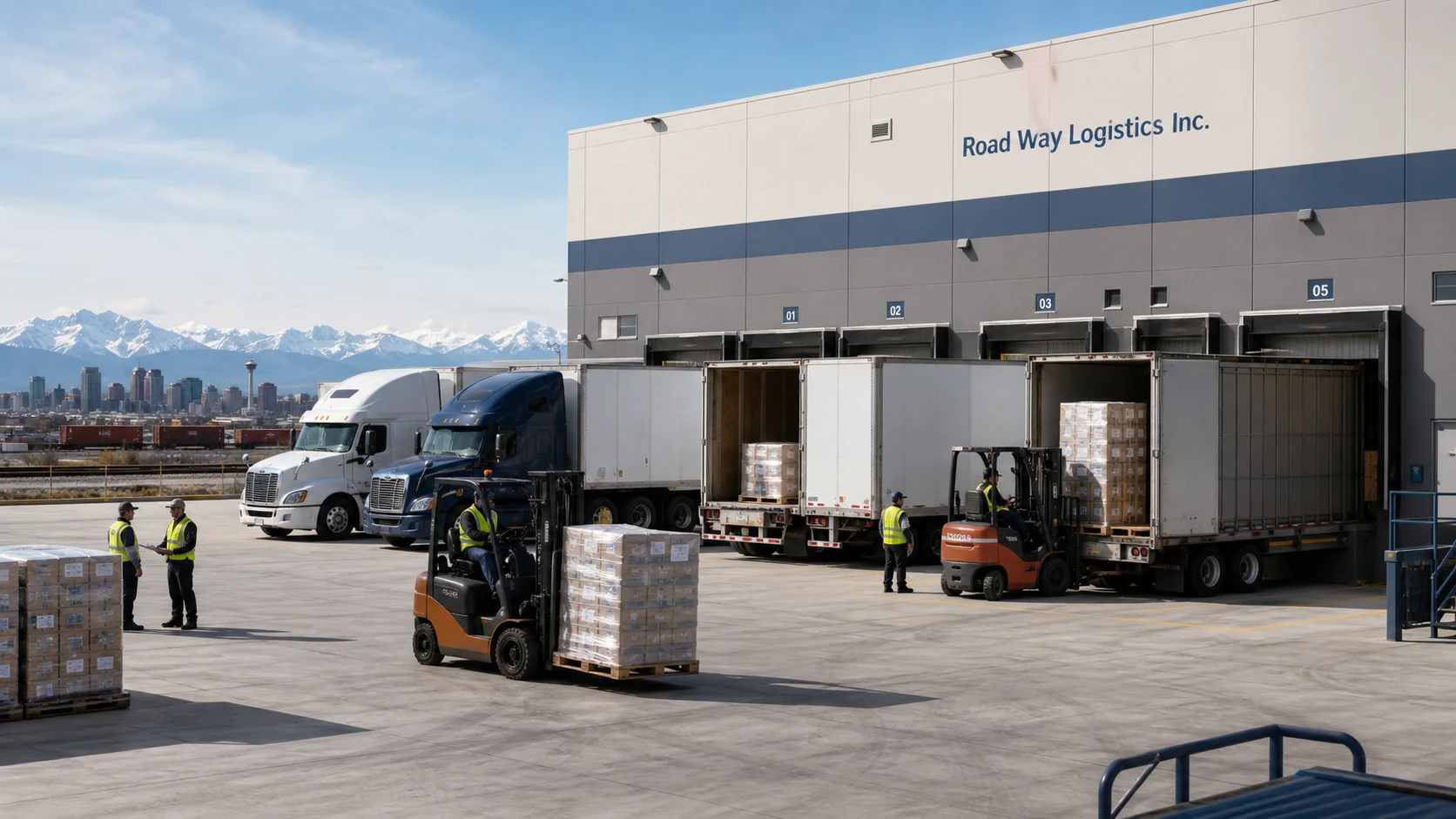
For Alberta businesses, logistics is not only about moving freight from one location to another. It is about speed, reliability, cost control, inventory movement, warehouse space, and customer satisfaction.
Whether your business operates in Calgary, Edmonton, Red Deer, Lethbridge, Airdrie, Medicine Hat, Fort McMurray, or across Western Canada, the way your freight moves can directly affect your delivery timelines and operating costs.
One logistics solution that helps businesses move freight faster is cross-docking.
Cross-docking is a logistics process where goods are received at a facility and quickly transferred from inbound transportation to outbound transportation with little or no long-term storage. Instead of keeping products in a warehouse for days or weeks, freight is unloaded, sorted, consolidated, staged, and moved out as quickly as possible.
For Alberta businesses, cross-docking can be especially useful because the province has long shipping distances, active industrial sectors, construction demand, retail distribution needs, e-commerce growth, and regular freight movement between Calgary, Edmonton, British Columbia, Saskatchewan, and other Western Canada routes.
At Roadway Logistics, we help businesses with cross-docking, warehousing, trucking, transloading, freight consolidation, and logistics support across Alberta.
What Is Cross-Docking?
Cross-docking is a supply chain method where products arrive at a warehouse or logistics facility and are transferred directly to outbound trucks or delivery routes.
The goal is simple:
Move freight in, sort it, and move it out quickly.
Unlike traditional warehousing, where products may be stored for a longer period, cross-docking focuses on reducing storage time and keeping freight moving through the supply chain.
Simple Example of Cross-Docking
A supplier sends a large shipment to Calgary. The shipment arrives at a cross-dock facility. Instead of being stored long-term, the freight is:
- Unloaded from the inbound truck
- Checked and sorted
- Separated by delivery location
- Re-palletized if needed
- Loaded onto outbound trucks
- Delivered to Calgary, Edmonton, Red Deer, Lethbridge, or other locations
This process helps businesses reduce unnecessary storage, improve delivery speed, and organize freight more efficiently.
Cross-Docking vs Traditional Warehousing
Cross-docking and warehousing are both important logistics services, but they are used for different purposes.
| Factor | Cross-Docking | Traditional Warehousing |
| Main purpose | Fast freight transfer | Inventory storage |
| Storage time | Minimal or short-term | Short-term or long-term |
| Best for | Goods ready for delivery | Goods that need to be stored |
| Freight movement | Inbound to outbound quickly | Stored, picked, packed, and shipped later |
| Cost focus | Reduces storage and handling time | Supports inventory management |
| Best business use | Fast-moving freight and distribution | Stock holding and order fulfillment |
Cross-docking is ideal when your freight already has a known destination and does not need to sit in storage. Traditional warehousing is better when you need inventory holding, pick-and-pack, long-term storage, or order fulfillment.
Many Alberta businesses need a combination of both.
How Cross-Docking Works
A well-managed cross-docking operation requires proper coordination, warehouse access, loading dock space, transportation planning, and clear communication.
Here is how the process usually works:
| Step | What Happens | Why It Matters |
| 1. Inbound freight arrives | Goods arrive by truck, container, trailer, or LTL carrier | Starts the transfer process |
| 2. Freight is unloaded | Pallets, cartons, or materials are removed from the inbound vehicle | Allows sorting and inspection |
| 3. Shipment is checked | Labels, counts, and delivery details are reviewed | Reduces delivery errors |
| 4. Freight is sorted | Goods are separated by route, customer, or destination | Improves delivery efficiency |
| 5. Freight is prepared | Pallets may be reworked, wrapped, labeled, or staged | Makes freight ready for outbound shipping |
| 6. Outbound loading begins | Freight is loaded onto delivery trucks or trailers | Keeps products moving |
| 7. Delivery is completed | Goods move to final destinations | Improves supply chain speed |
The main benefit is that products spend less time sitting in storage and more time moving toward the customer.
When Should Alberta Businesses Use Cross-Docking?
Cross-docking is not necessary for every shipment, but it can be very useful in the right situation.
Alberta businesses should consider cross-docking when they need:
- Faster freight movement
- Short-term staging instead of long-term storage
- Freight consolidation
- LTL shipment support
- Pallet breakdown or rework
- Multi-location distribution
- Retail replenishment
- Construction site deliveries
- Industrial freight movement
- Better warehouse space management
- Regional distribution across Calgary and Alberta
1. When You Need Faster Freight Movement
Speed is one of the biggest reasons businesses use cross-docking.
If your freight is ready to move and does not need to be stored, cross-docking can help reduce delays. Instead of receiving freight into a warehouse and holding it for days, the shipment can be transferred quickly to outbound delivery routes.
This is useful for businesses that deliver to:
- Calgary
- Edmonton
- Red Deer
- Airdrie
- Lethbridge
- Medicine Hat
- Fort McMurray
- Grande Prairie
- Saskatoon
- Vancouver
- Regina
- Western Canada routes
For Calgary businesses, cross-docking can support faster movement between suppliers, warehouses, customers, job sites, and distribution points.
2. When Your Freight Does Not Need Long-Term Storage
If your products are already sold, assigned, or ready for delivery, long-term warehousing may add unnecessary cost.
Cross-docking works best when goods already have a clear next destination.
Cross-Docking Is Ideal For:
| Freight Type | Why Cross-Docking Helps |
| Retail replenishment | Moves stock quickly to stores |
| Construction materials | Sends products directly to job sites |
| Industrial supplies | Reduces downtime for urgent materials |
| E-commerce bulk shipments | Speeds up regional distribution |
| LTL freight | Helps sort and consolidate smaller loads |
| Seasonal products | Reduces warehouse congestion |
| Pre-sold inventory | Avoids unnecessary storage costs |
If the freight does not need to sit in storage, cross-docking can make the process faster and more efficient.
3. When You Want to Reduce Warehousing Costs
Warehousing is useful, but it can become expensive when products sit longer than needed.
Storage costs can include:
- Warehouse space
- Labour
- Equipment handling
- Inventory management
- Pallet storage
- Product movement
- Long-term storage charges
Cross-docking helps reduce these costs by keeping freight moving.
Instead of paying to store products that are already ready for delivery, businesses can use a cross-dock warehouse to receive, sort, and ship goods quickly.
This is especially helpful for Alberta businesses with:
- High shipment volume
- Multiple delivery points
- Seasonal demand
- Limited warehouse space
- Fast-moving products
- Tight delivery schedules
- Regular supplier shipments
4. When You Need Freight Consolidation
Freight consolidation is one of the most common reasons businesses use cross-docking.
Sometimes, a business receives multiple smaller shipments from different suppliers. Instead of sending each shipment separately, a cross-dock facility can combine them into one organized outbound load.
Example
A Calgary-based distributor receives freight from three suppliers.
Instead of sending each shipment separately to Edmonton, Red Deer, and Lethbridge, the freight is brought to a cross-dock facility, sorted, and consolidated into more efficient delivery routes.
Benefits of Freight Consolidation
- Fewer delivery trips
- Better truck space usage
- Lower transportation waste
- Easier route planning
- More organized deliveries
- Reduced handling confusion
- Better regional distribution
For businesses shipping across Alberta, freight consolidation can make the entire delivery process more efficient.
5. When You Need LTL Freight Support
Many businesses do not always ship full truckloads. They rely on LTL freight, also known as less-than-truckload shipping.
Cross-docking can help organize LTL freight by sorting, staging, and transferring smaller shipments between carriers or delivery routes.
Cross-Docking Can Help With:
- LTL freight transfer
- Pallet sorting
- Carrier coordination
- Short-term staging
- Shipment labeling
- Load reconfiguration
- Multi-stop delivery planning
- Regional freight distribution
For Calgary businesses, cross-docking can be a useful solution when freight needs to move between local delivery, regional trucking, or long-haul carriers.
6. When You Need Transloading Support
Cross-docking and transloading are often connected, but they are not exactly the same.
| Service | Meaning | Example |
| Cross-docking | Moving freight quickly from inbound to outbound transport | Truck to truck transfer |
| Transloading | Moving freight between different transport modes or equipment types | Container to truck transfer |
| Warehousing | Storing inventory for short-term or long-term use | Products stored before fulfillment |
| Freight consolidation | Combining smaller shipments into one larger load | Multiple supplier shipments combined for delivery |
Transloading is useful when goods arrive by container, rail, or long-haul transportation and need to be transferred to local or regional delivery trucks.
For Alberta businesses, combining cross-docking and transloading can help improve freight movement across Calgary, Edmonton, and Western Canada.
7. When Your Business Has Seasonal Demand
Many Alberta businesses experience seasonal demand.
This can happen in:
- Retail
- Construction
- Agriculture
- Food and beverage
- E-commerce
- Industrial supply
- Oilfield supply
- Home improvement
- Event and promotional products
During busy seasons, warehouse space can fill quickly. Cross-docking helps businesses handle extra freight volume without relying only on long-term storage.
Seasonal Cross-Docking Example
A Calgary retailer receives extra inventory before a busy sales season. Instead of storing all products in a warehouse, the business uses cross-docking to sort and move products quickly to stores, customers, or regional delivery locations.
This helps reduce congestion and keeps products moving.
8. When You Deliver to Multiple Locations
Cross-docking is very useful when one shipment needs to be split into several deliveries.
This is common for businesses with:
- Multiple retail stores
- Several branches
- Construction job sites
- Dealer networks
- Wholesale customers
- Service locations
- Regional customers across Alberta
A cross-dock facility can receive one large inbound shipment, break it down by destination, and send each portion to the correct location.
Multi-Location Distribution Example
| Inbound Shipment | Cross-Dock Action | Outbound Delivery |
| One full truckload arrives in Calgary | Freight is sorted by location | Calgary, Edmonton, Red Deer, Lethbridge |
| Multiple supplier loads arrive | Freight is consolidated | One organized Alberta delivery route |
| Mixed pallets arrive | Pallets are separated and labeled | Different customer locations |
This makes the delivery process easier to manage and more reliable.
9. When You Want to Reduce Product Handling
Every time freight is handled, there is a chance of delay, damage, or error.
Cross-docking can reduce unnecessary handling because products do not go through a long storage and picking process.
Instead of this:
Receive → Store → Pick → Stage → Load → Deliver
Cross-docking follows a faster process:
Receive → Sort → Stage → Load → Deliver
This can help businesses improve efficiency and reduce operational complexity.
10. When You Need More Supply Chain Flexibility
Alberta businesses often deal with changing delivery schedules, long distances, weather challenges, supplier delays, and customer demand changes.
Cross-docking gives businesses more flexibility because freight can be:
- Redirected
- Consolidated
- Sorted
- Re-labeled
- Staged temporarily
- Sent to different delivery routes
- Transferred between carriers
This makes cross-docking helpful for businesses that need practical, flexible logistics support.
Industries in Alberta That Benefit from Cross-Docking
Cross-docking can support many industries across Alberta.
| Industry | How Cross-Docking Helps |
| Retail | Speeds up store replenishment and product distribution |
| E-commerce | Moves bulk shipments faster to delivery networks |
| Construction | Sends materials directly to job sites |
| Industrial supply | Improves movement of parts, tools, and equipment |
| Oilfield supply | Helps urgent freight reach service locations faster |
| Food and beverage | Supports faster movement of packaged goods |
| Manufacturing | Connects suppliers, production sites, and customers |
| Wholesale distribution | Organizes large inbound and outbound shipments |
Cross-Docking for Retail and E-Commerce
Retail and e-commerce businesses need speed, accuracy, and reliable delivery.
Cross-docking can help with:
- Store replenishment
- Online order distribution
- Vendor shipment consolidation
- Seasonal product movement
- Promotional inventory
- Bulk product distribution
- Returns support when needed
For businesses serving customers in Calgary and across Alberta, cross-docking can reduce delays and improve delivery flow.
Cross-Docking for Construction Companies
Construction companies often need materials delivered directly to job sites.
Cross-docking can help construction businesses manage:
- Building supplies
- Palletized materials
- Tools and equipment
- Drywall and construction products
- Site-specific deliveries
- Multi-project distribution
- Supplier-to-job-site freight
For Calgary construction projects, cross-docking can help reduce delays caused by poor material coordination.
Cross-Docking for Industrial and Oilfield Freight
Alberta has strong industrial and energy sectors. Many companies need parts, equipment, tools, and supplies delivered quickly.
Cross-docking can support:
- Urgent equipment shipments
- Industrial materials
- Maintenance supplies
- Parts distribution
- Field service deliveries
- Regional freight movement
- Heavy-duty commercial shipments
When downtime is costly, faster freight movement becomes very important.
Benefits of Cross-Docking for Alberta Businesses
Cross-docking offers several practical benefits.
| Benefit | Business Impact |
| Faster delivery | Products move quickly to customers or job sites |
| Lower storage time | Less need for long-term warehousing |
| Better warehouse space usage | Reduces congestion and improves flow |
| Freight consolidation | Combines shipments for better delivery planning |
| Improved route efficiency | Helps organize regional deliveries |
| Reduced handling | Less movement can reduce errors and delays |
| Better flexibility | Supports changing schedules and delivery needs |
| Stronger distribution | Helps businesses serve multiple Alberta locations |
When Cross-Docking May Not Be the Best Option
Cross-docking is useful, but it is not right for every shipment.
It may not be the best option when:
- Products need long-term storage
- Inventory does not have a confirmed destination
- Orders require detailed picking and packing
- Shipment information is incomplete
- Supplier timing is unreliable
- Goods need special storage conditions
- Freight needs major processing before delivery
- Outbound delivery is not scheduled
Cross-docking works best when inbound and outbound movement is planned properly.
Why Calgary Is a Strong Location for Cross-Docking
Calgary is one of Alberta’s most important logistics and distribution markets.
For businesses moving freight across Alberta and Western Canada, Calgary offers strong access to:
- Major highways
- Regional trucking routes
- Industrial areas
- Warehousing zones
- Intermodal transportation
- Airport cargo movement
- Distribution networks
- Alberta and Western Canada markets
Because of this, Calgary is a practical location for cross-docking, freight consolidation, warehousing, and regional distribution.
For businesses that regularly ship through Calgary, a cross-dock facility can help reduce delays and improve transportation planning.
What to Look for in a Calgary Cross-Docking Partner
Choosing the right logistics provider matters.
A good cross-docking partner should offer more than dock space. They should understand freight movement, carrier coordination, warehouse handling, and Alberta delivery routes.
Look for a Provider That Offers:
- Cross-docking in Calgary
- Alberta-wide logistics support
- Short-term freight staging
- Pallet breakdown and rework
- Freight consolidation
- Transloading services
- Warehousing support
- Trucking and delivery coordination
- LTL freight handling
- Clear communication
- Flexible scheduling
- Local route knowledge
The right partner can help reduce delays and make freight movement easier to manage.
Why Choose Roadway Logistics for Cross-Docking in Alberta?
Roadway Logistics provides practical logistics solutions for businesses that need reliable freight movement across Calgary and Alberta.
We support businesses with:
- Cross-docking
- Warehousing
- Trucking
- Transloading
- Freight consolidation
- Short-term staging
- LTL freight support
- Pallet rework
- Regional distribution
- Drayage support
- Local and long-haul freight coordination
Whether your business needs to move pallets across Calgary, consolidate shipments for Alberta delivery, transfer freight between carriers, or reduce warehouse storage time, Roadway Logistics can help.
Our goal is to make your freight movement simpler, faster, and more organized.
Local Areas We Serve
Roadway Logistics supports businesses across Calgary and Alberta.
| Main Service Area | Nearby Alberta Locations |
| Calgary | Airdrie, Chestermere, Okotoks, Cochrane, Balzac, Rocky View County |
| Central Alberta | Red Deer, Lacombe, Olds, Innisfail |
| Edmonton Region | Edmonton, Nisku, Leduc, Sherwood Park, St. Albert |
| Southern Alberta | Lethbridge, Medicine Hat, Brooks |
| Northern Alberta | Fort McMurray, Grande Prairie |
| Western Canada Routes | British Columbia, Saskatchewan, Manitoba connections |
This table is better than adding a long city list in paragraph form because it looks cleaner and helps local SEO without making the article feel spammy.
Common Cross-Docking Services Businesses Need
Businesses searching for cross-docking in Calgary or Alberta often need more than basic freight transfer.
Roadway Logistics can support common cross-docking needs such as:
- Inbound freight unloading
- Outbound freight loading
- Short-term staging
- Pallet breakdown
- Pallet rework
- Re-palletizing
- Shrink-wrapping
- Shipment sorting
- Freight consolidation
- LTL freight transfer
- Load reconfiguration
- Inventory verification
- Shipment labeling
- Transloading
- Local trucking
- Regional distribution
- Warehouse support
- Final-mile delivery coordination
These services help businesses keep freight moving and reduce unnecessary delays.
Cross-Docking Checklist: Is It Right for Your Business?
Use this checklist to decide whether cross-docking may be a good fit.
| Question | If Yes, Cross-Docking May Help |
| Do your shipments already have confirmed destinations? | Yes |
| Do you want to reduce warehouse storage time? | Yes |
| Do you deliver to multiple Alberta locations? | Yes |
| Do you receive freight from multiple suppliers? | Yes |
| Do you use LTL freight? | Yes |
| Do you need pallet sorting or rework? | Yes |
| Do you have seasonal freight spikes? | Yes |
| Do you need faster delivery in Calgary or Alberta? | Yes |
| Do you want to improve freight consolidation? | Yes |
| Do you need short-term staging instead of storage? | Yes |
If several of these apply to your business, cross-docking could improve your logistics process.
Final Thoughts
Cross-docking is a smart logistics solution for Alberta businesses that want faster freight movement, less storage time, better delivery planning, and more flexible distribution.
It is especially useful when goods are already assigned to customers, stores, job sites, branches, or regional delivery points.
For Calgary businesses, cross-docking can be a strong advantage because Calgary is a major logistics location for Alberta and Western Canada. With the right logistics partner, your business can reduce delays, improve freight coordination, and move products more efficiently.
If your business needs cross-docking, warehousing, trucking, transloading, or freight consolidation in Calgary or across Alberta, Roadway Logistics is ready to help.
Need Cross-Docking Services in Calgary or Alberta?
Roadway Logistics provides reliable logistics support for businesses that need fast, organized, and efficient freight movement.
Contact Roadway Logistics today to discuss your shipment, warehouse needs, or Alberta distribution plan.
Roadway Logistics
Website: roadwaylogistics.ca
Services: Cross-docking, warehousing, trucking, transloading, drayage, freight consolidation, and distribution
Service Areas: Calgary, Edmonton, and Alberta-wide logistics support
Frequently Asked Questions About Cross-Docking
What is cross-docking in logistics?
Cross-docking is a logistics process where goods are received at a facility and quickly transferred to outbound transportation with little or no long-term storage.
Is cross-docking the same as warehousing?
No. Warehousing focuses on storing inventory. Cross-docking focuses on moving freight quickly through a facility. However, many businesses use both services together.
Is cross-docking available in Calgary?
Yes. Calgary businesses can use cross-docking to sort, stage, consolidate, and move freight across Alberta and Western Canada.
What types of businesses use cross-docking?
Retailers, wholesalers, manufacturers, construction companies, industrial suppliers, e-commerce businesses, and distributors often use cross-docking.
Does cross-docking reduce logistics costs?
Cross-docking can help reduce storage time, handling steps, and warehouse congestion. The exact savings depend on freight volume, routes, timing, and shipment type.
What is the difference between cross-docking and transloading?
Cross-docking usually means moving freight from inbound transportation to outbound transportation quickly. Transloading usually means transferring freight between different transportation modes, such as container to truck or rail to truck.
Is cross-docking useful for LTL freight?
Yes. Cross-docking can help sort, stage, and consolidate LTL shipments for more organized delivery.
Can cross-docking help with Alberta-wide distribution?
Yes. Cross-docking can help businesses distribute freight to Calgary, Edmonton, Red Deer, Lethbridge, Medicine Hat, Fort McMurray, Grande Prairie, and other Alberta locations.