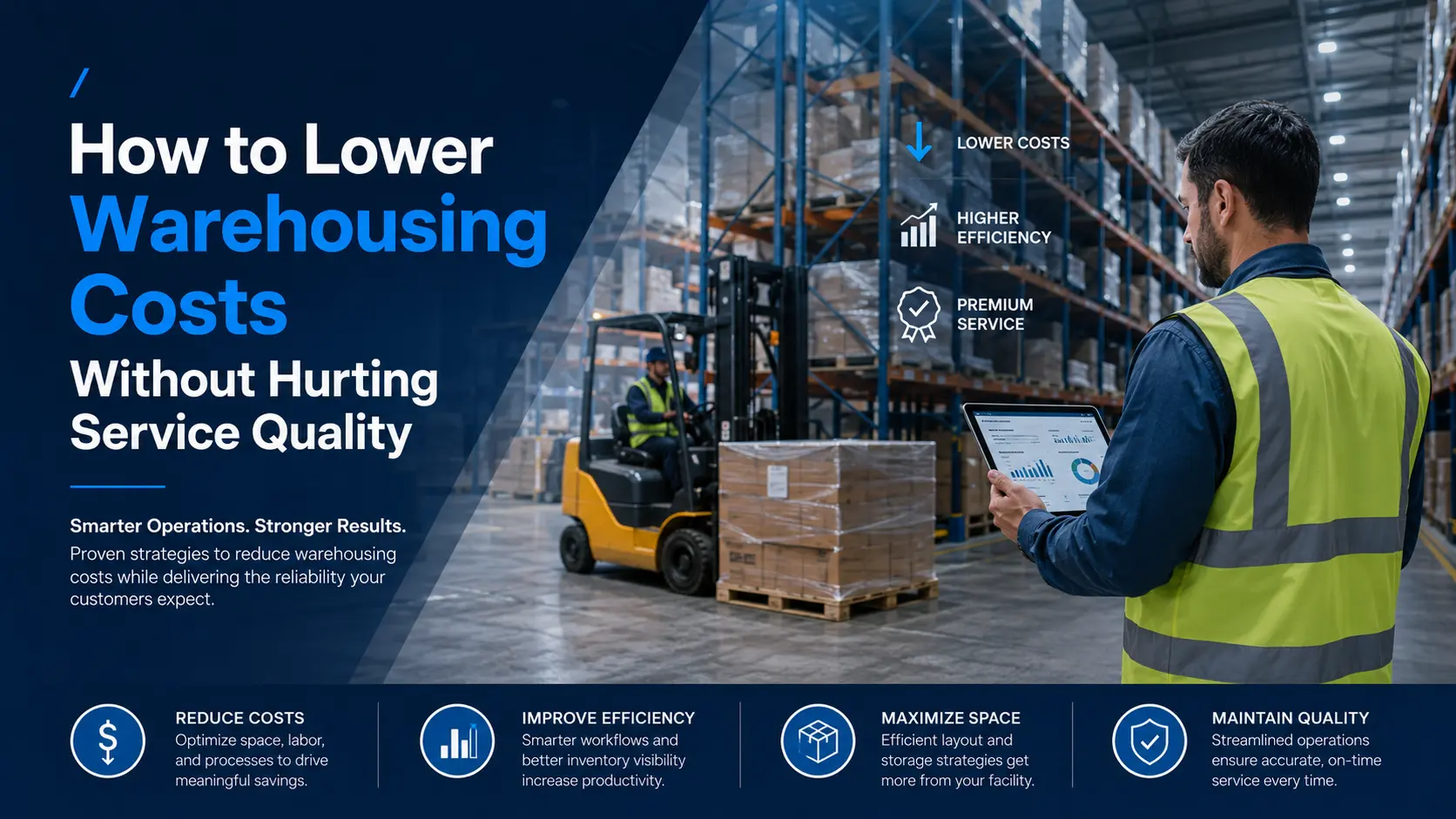
Warehousing costs can rise quietly. Rent, labour, equipment, insurance, utilities, packaging, inventory carrying cost, damaged goods, inefficient picking, and slow freight movement all affect margins. Cutting costs without a plan can hurt service quality, but improving warehouse design and logistics workflow can reduce waste while keeping customers satisfied.
For Calgary and Alberta businesses, lowering warehousing costs does not always mean leasing cheaper space or reducing staff. In many cases, the better answer is flexible 3PL warehousing, cross-docking, smarter inventory staging, improved slotting, freight consolidation, and clearer order workflows. Roadway Logistics supports businesses with warehousing, pick and pack, cross-docking, transloading, trucking, freight consolidation, and 3PL support.
Service Fit for Roadway Logistics
| Roadway Service | How It Supports This Topic |
| Warehousing | Short-term storage, overflow storage, receiving, staging, and inventory support |
| Cross-docking | Fast transfer from inbound freight to outbound routes |
| Transloading | Transfer between containers, trailers, pallets, and local delivery vehicles |
| Trucking | LTL, FTL, flat deck, cartage, regional distribution, and Alberta freight movement |
| Pick and pack | Order preparation, kit support, bundled items, and fulfillment workflows |
| Specialized handling | Support for high-value, fragile, heavy, awkward, or sensitive freight |
Understand the Real Cost of Warehousing
Many businesses only look at rent when evaluating warehouse cost. That is a mistake. The real cost includes space, labour, equipment, handling, inventory carrying cost, damage, shrinkage, administration, technology, freight inefficiency, returns, and customer service issues caused by slow or inaccurate fulfillment.
A warehouse that appears inexpensive can become costly if it causes delays, picking errors, damage, congestion, or high transportation costs. Service quality must be part of the cost equation.
| Cost Category | Examples | How It Affects Service |
| Space | Rent, utilities, yard, dock areas | Too little space causes congestion |
| Labour | Receiving, picking, packing, loading | Poor planning slows order flow |
| Equipment | Forklifts, pallet jacks, racking | Wrong equipment increases handling time |
| Inventory | Overstock, slow movers, safety stock | Excess stock consumes storage space |
| Freight | LTL, FTL, carrier delays | Poor coordination increases cost and lead time |
| Errors | Wrong picks, damages, returns | Customer trust and margins suffer |
Use Flexible 3PL Warehousing Instead of Fixed Overhead
A fixed warehouse lease can be expensive when demand changes. Businesses may pay for unused space in slow periods and still run out of capacity during busy periods. Flexible 3PL warehousing can help companies adjust storage and handling support based on actual business needs.
This is especially useful for seasonal inventory, market expansion, project freight, temporary overflow, imported goods, retail replenishment, industrial supplies, and e-commerce growth. Instead of carrying all infrastructure internally, a business can use a 3PL partner for the parts of the operation that need more flexibility.
| Fixed Warehouse Model | Flexible 3PL Model |
| Long-term lease commitment | Storage support based on need |
| Internal staffing burden | Warehouse labour support through provider |
| Equipment investment | Use provider infrastructure |
| Hard to scale quickly | Easier to support seasonal volume |
| Higher management workload | Outsourced operational execution |
Reduce Storage Time With Cross-Docking
Not every shipment needs long-term storage. If products already have a destination, cross-docking can move freight through the facility quickly. This can reduce storage costs, decrease handling steps, and improve delivery speed.
Cross-docking works well for retailers, distributors, construction suppliers, industrial businesses, and brands that receive freight for several customers or locations. The key is knowing which freight should be stored and which freight should move directly to outbound staging.
| Best Cross-Docking Use Case | Why It Lowers Cost |
| Pre-sold inventory | Avoids unnecessary storage |
| Multi-location distribution | Sorts freight by destination quickly |
| Seasonal promotions | Moves large batches through the facility |
| Supplier consolidation | Combines inbound freight for efficient outbound loads |
| LTL transfers | Improves routing and staging |
Improve Warehouse Slotting
Slotting means placing inventory in the warehouse based on movement, size, handling needs, and order patterns. Poor slotting wastes labour because workers spend too much time walking, searching, moving obstacles, or handling products more than necessary.
Fast-moving SKUs should be easier to access. Heavy or awkward products should be placed where handling is safe and efficient. Slow movers should not occupy the most valuable picking locations. Better slotting lowers labour cost and improves service quality at the same time.
| Slotting Rule | Operational Benefit |
| Fast movers near pick zones | Reduces travel time |
| Heavy goods near handling equipment | Improves safety and speed |
| Slow movers in lower-priority space | Protects prime warehouse locations |
| Similar SKUs separated clearly | Reduces picking mistakes |
| Returns staged separately | Prevents confusion with sellable inventory |
Control Inventory Instead of Storing Everything
Warehouse cost often rises because businesses store too much of the wrong inventory. Slow-moving products, obsolete items, damaged goods, unprocessed returns, and excess safety stock consume space that could support revenue-producing activity.
Businesses should review inventory by movement, margin, seasonality, supplier lead time, and customer importance. This helps separate what needs local storage from what can remain centralized or move through cross-docking.
| Inventory Type | Recommended Action |
| Fast movers | Store close to pick and dispatch areas |
| Seasonal items | Use temporary or flexible storage |
| Slow movers | Review stock levels and storage priority |
| Obsolete goods | Clear, return, liquidate, or dispose according to policy |
| Damaged goods | Separate and process quickly |
| Returns | Inspect and restock or isolate |
Consolidate Freight to Lower Total Cost
Warehouse cost and freight cost are connected. If a warehouse sends too many small shipments separately, transportation costs rise. If inbound freight arrives in a disorganized way, receiving labour rises. Freight consolidation helps reduce waste by grouping shipments and improving route planning.
A 3PL can receive freight, consolidate loads, stage outbound routes, and coordinate LTL or FTL movement. This is often more effective than trying to reduce warehouse cost in isolation.
Protect Service Quality While Cutting Cost
Cost reduction should never begin by weakening the customer experience. The better approach is to remove waste from the operation. That means reducing touches, improving inventory layout, shortening travel paths, using cross-docking where appropriate, staging freight earlier, and improving communication.
Service quality should be measured through order accuracy, on-time shipping, damage rate, receiving speed, return processing time, and customer communication. A lower-cost warehouse that performs poorly is not actually cheaper.
| Metric | Why It Matters |
| Order accuracy | Protects customer trust and reduces returns |
| On-time shipping | Maintains service promises |
| Damage rate | Protects margins and customer satisfaction |
| Dock-to-stock time | Shows how quickly inbound goods become available |
| Inventory accuracy | Prevents overselling and stock confusion |
| Return cycle time | Recovers value from returned products |
How Roadway Logistics Can Help
Roadway Logistics helps Calgary and Alberta businesses lower warehousing costs without sacrificing service quality through flexible warehousing, pick and pack, cross-docking, transloading, freight consolidation, trucking, LTL, FTL, drayage, and 3PL support. The goal is to create a more efficient flow of goods rather than simply reduce storage space.
Whether your business needs overflow storage, market expansion support, faster freight movement, lower handling time, or a more flexible warehouse model, Roadway Logistics can help design a practical workflow around your products, customers, and service requirements.
Local Service Areas
Roadway Logistics can position this topic around Calgary, Edmonton, and Alberta-wide service coverage. The local SEO copy should naturally mention Calgary, Edmonton, Red Deer, Airdrie, Balzac, Rocky View County, Lethbridge, Medicine Hat, Fort McMurray, Grande Prairie, and nearby Alberta markets when relevant to the page.
| Area | Use in Content |
| Calgary | Primary service city and warehouse/trucking hub |
| Edmonton | Secondary Alberta logistics market |
| Red Deer | Central Alberta distribution corridor |
| Airdrie, Balzac, Rocky View County | Nearby industrial and warehouse-focused service areas |
| Lethbridge and Medicine Hat | Southern Alberta delivery and distribution references |
| Fort McMurray and Grande Prairie | Northern Alberta and industrial freight references |
Frequently Asked Questions
How can a business lower warehousing costs?
A business can lower costs by improving inventory control, using flexible 3PL warehousing, reducing storage time with cross-docking, improving slotting, consolidating freight, and reducing handling errors.
Does cheaper warehouse space always save money?
No. A cheaper warehouse can cost more if it creates delays, damage, picking errors, poor inventory control, or higher transportation costs.
What is cross-docking and how does it reduce costs?
Cross-docking moves freight from inbound receiving to outbound shipping quickly, often with little or no long-term storage. This can reduce storage time and handling.
What is warehouse slotting?
Warehouse slotting is the process of placing products in locations based on movement, size, handling needs, and order patterns to improve efficiency.
Can Roadway Logistics help reduce warehousing costs?
Yes. Roadway Logistics supports flexible warehousing, cross-docking, transloading, pick and pack, freight consolidation, and trucking for Calgary and Alberta businesses.
A Word From Roadway Logistics
If your business needs to lower warehousing costs without hurting service quality, contact Roadway Logistics for flexible warehousing, 3PL, cross-docking, transloading, and freight coordination in Calgary and Alberta.
Contact Roadway Logistics today. Phone: +1 587-350-7615. Email: dispatch@roadwaylogistics.ca. Calgary: 1000 55 Ave NE, Calgary, AB T2E 6Y4, Canada. Edmonton: 20508 118A Ave Edmonton Alberta T5S 2S7.