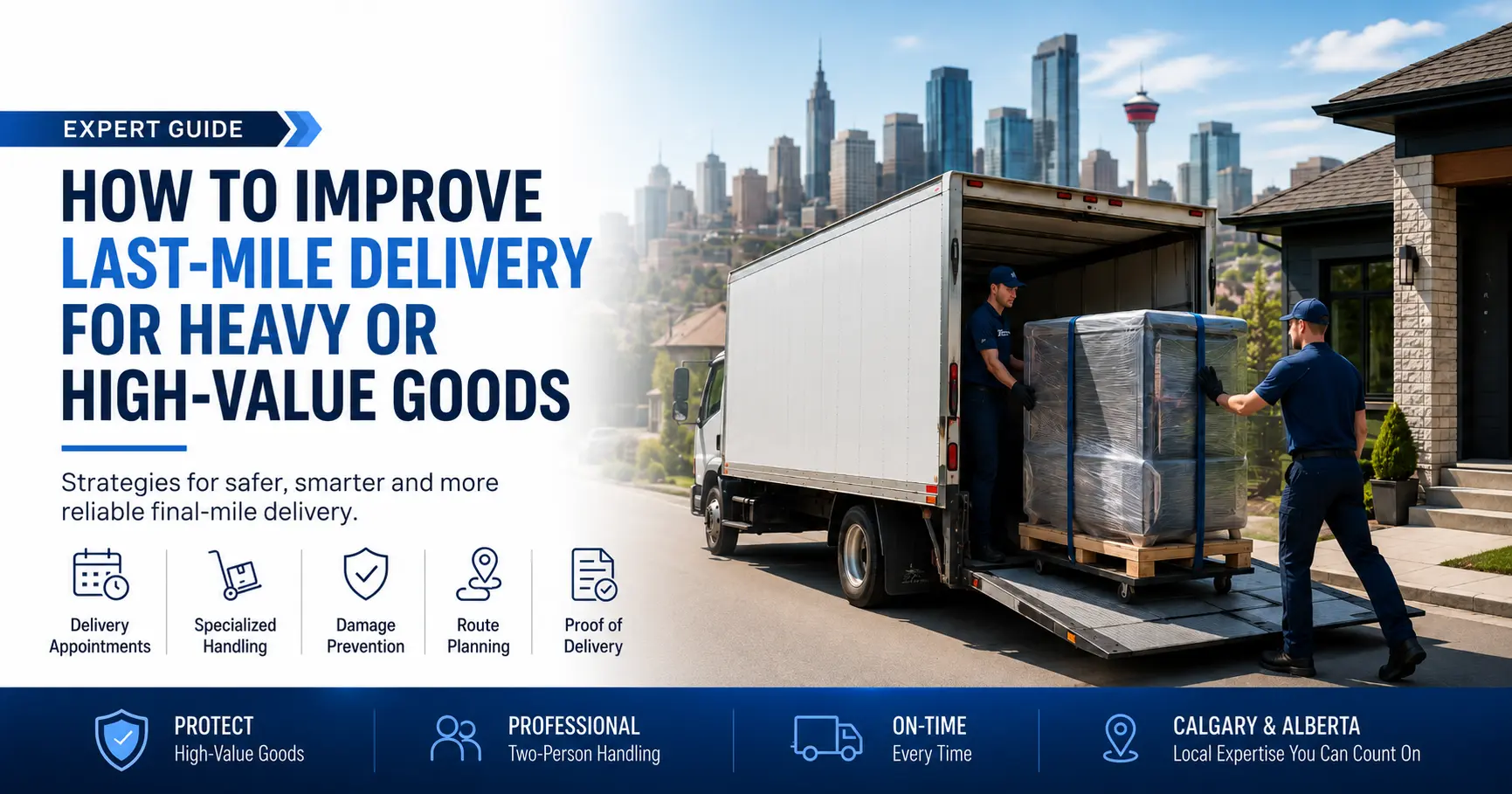
To improve last mile delivery for heavy or high-value goods, businesses need to manage much more than the final drive to the customer.
The most reliable final-mile operations begin before the truck leaves the warehouse. Delivery appointments, site-access information, correct vehicle selection, appropriate handling equipment, secure staging, customer communication, delivery sequencing, proof of delivery, and exception planning all influence whether the final handoff succeeds.
These requirements become especially important when the shipment involves furniture, appliances, machinery, electronics, medical equipment, commercial fixtures, oversized goods, or other products that cannot simply be left at a doorstep.
For businesses in Calgary and across Alberta, last-mile delivery can also involve commercial buildings, construction sites, loading docks, residential properties, narrow access points, winter conditions, rural destinations, and customers who must be present to accept the shipment.
The goal is therefore not simply to make the final mile faster.
It is to make it more predictable, damage-resistant, efficient, and appropriate for the product being delivered.
Why Heavy and High-Value Last-Mile Delivery Is Different
Standard parcel delivery is generally built around speed and volume.
A driver can deliver many small packages during a route because the products are relatively easy to handle and the delivery process is simple.
Heavy and high-value freight creates a different operating environment.
A final-mile shipment may require:
- an appointment with the customer
- a loading dock reservation
- liftgate or tailgate equipment
- two-person handling
- specialized moving equipment
- protective coverings
- inside delivery
- room-of-choice placement
- unpacking
- assembly or positioning
- removal of packaging
- signature or proof of delivery
- additional security or handling controls
The shipment may also be too valuable, fragile, large, or operationally important to leave unattended.
A missed appointment for a small parcel is inconvenient.
A failed delivery involving a 300-kilogram machine, commercial appliance, medical device, or custom furniture order can create an expensive chain of problems involving additional trucking, labour, customer-service time, storage, and rescheduling.
That is why heavy and high-value final-mile delivery should be planned as an operational process rather than treated as the last line on a freight quote.
Common Last-Mile Problems and How to Prevent Them
| Last-Mile Problem | Typical Result | Better Approach |
|---|---|---|
| Customer not available | Failed delivery and redelivery cost | Confirm appointment and contact information |
| Wrong vehicle | Freight cannot be unloaded safely | Match equipment to weight, dimensions and site |
| No liftgate or dock | Delivery cannot be completed | Confirm unloading conditions before dispatch |
| Incomplete access information | Driver delayed at destination | Collect site and access details in advance |
| Poor staging | Wrong freight loaded or excessive rehandling | Stage by route and delivery sequence |
| Weak packaging | Damage during final handling | Inspect packaging before dispatch |
| Wrong crew size | Unsafe or delayed delivery | Match personnel to handling requirements |
| No inside-delivery planning | Freight stops at curb or entrance | Define service level before booking |
| Poor communication | Customer uncertainty and missed appointments | Send clear delivery-window updates |
| No proof of condition | Damage disputes become difficult | Document shipment and delivery condition |
The earlier these issues are addressed, the less likely they are to become expensive problems at the customer’s location.
Start Last-Mile Planning at the Warehouse
Last-mile performance is often blamed on the driver.
In reality, many delivery failures begin inside the warehouse.
If freight is staged incorrectly, packaged poorly, loaded in the wrong sequence, assigned to unsuitable equipment, or dispatched with incomplete delivery information, the driver may have very limited ability to fix the problem.
A strong final-mile workflow begins by asking:
What is being delivered?
Where is it going?
Who is receiving it?
How will it be unloaded?
Where must the product ultimately be placed?
What equipment and people are required?
What could prevent the delivery from being completed on the first attempt?
Answering those questions before dispatch changes the entire quality of the delivery plan.
Choose the Correct Delivery Service Level
One of the biggest sources of last-mile confusion is failing to define what “delivery” actually means.
Different customers may expect completely different outcomes from the same phrase.
Dock-to-Dock Delivery
This is appropriate when the destination has a commercial receiving dock and personnel capable of unloading the freight.
The carrier’s responsibility normally ends once the freight reaches the designated receiving point.
Curbside Delivery
The shipment is delivered to an accessible exterior location.
This may work for businesses or customers that have the equipment and personnel to move the product themselves.
For large or high-value goods, however, curbside service may not meet the customer’s actual expectations.
Threshold Delivery
The shipment moves beyond the curb and into an initial protected area such as an entrance, garage, or receiving area.
Inside Delivery
Inside delivery is useful when the shipment needs to move beyond the loading dock or exterior entrance.
For commercial and residential deliveries that require this additional handling, businesses should understand what is included in the selected inside delivery service in Calgary before the shipment is dispatched.
Room-of-Choice Delivery
Some deliveries need to reach a specific office, room, floor, department, showroom, or installation location.
This requires more planning because the delivery team must understand the building layout and access restrictions before arrival.
White Glove Delivery
High-value, fragile, sensitive, or presentation-critical products may require a more complete final-mile service.
Depending on the shipment, white glove delivery may involve additional handling, inside placement, unpacking, setup, assembly, installation support, or packaging removal.
The important point is not that every high-value shipment requires white glove service.
It is that the service level needs to be explicitly defined before the delivery is priced, scheduled, and dispatched.
Collect Site Information Before the Delivery Day
A street address tells the driver where the building is.
It does not explain how the delivery will actually happen.
For heavy or high-value shipments, collect destination details in advance.
Useful information includes:
- loading dock availability
- dock height or limitations
- liftgate requirements
- receiving hours
- appointment requirements
- contact person
- security procedures
- parking restrictions
- loading-zone restrictions
- building entrance
- elevator dimensions
- freight elevator availability
- stairs
- narrow doors or corridors
- floor level
- room-of-choice requirements
- construction-site access
- equipment available at destination
- customer equipment limitations
This information becomes particularly important for downtown commercial properties, healthcare facilities, offices, retail stores, high-rise buildings, construction sites, and residential deliveries involving bulky products.
A five-minute site-access conversation can prevent hours of delay.
Confirm the Delivery Appointment
Heavy and high-value final-mile deliveries frequently require someone to be present.
That makes appointment management a core logistics function.
A good process should confirm:
Delivery date
Expected delivery window
Customer contact
Destination
Service level
Access requirements
Any special instructions
The appointment should be confirmed early enough that changes do not disrupt route planning.
For example, discovering at the destination that a receiving dock closes at 3:00 PM creates a completely different problem than knowing the restriction before the route begins.
Improve Pre-Delivery Communication
Customers should not be left wondering when an important shipment will arrive.
Clear communication can reduce:
- missed appointments
- customer-service calls
- site-access problems
- driver waiting time
- confusion about unloading
- disputes over delivery expectations
The customer should understand what they need to do before the truck arrives.
For example:
Ensure the receiving area is accessible.
Reserve the freight elevator.
Confirm that the site contact will be present.
Remove vehicles or obstacles from the unloading area.
Arrange any required building access.
Notify security or site management.
Clear instructions make the delivery a coordinated appointment rather than a surprise truck arrival.
Match the Vehicle to the Freight and Destination
Vehicle selection should be based on more than shipment weight.
Consider:
- freight dimensions
- overall weight
- number of pieces
- packaging
- unloading requirements
- destination access
- dock availability
- height restrictions
- parking space
- weather exposure
- handling equipment
A shipment may fit inside a vehicle but still be impossible to unload safely at the destination.
Liftgate Requirements
If the destination does not have a loading dock or suitable unloading equipment, a liftgate may be required.
This should be identified before dispatch.
Heavy or Oversized Freight
Machinery, industrial parts, large fixtures, construction products, and irregular goods may require a completely different transportation plan from standard boxed freight.
Businesses moving these products can review the planning considerations for industrial equipment and heavy goods logistics.
Restricted Urban Access
Downtown buildings, narrow streets, underground loading areas, and residential communities may restrict the type of vehicle that can reach the final destination.
Using a vehicle that is unnecessarily large can create just as many problems as using one that is too small.
Match the Crew to the Delivery
The equipment can be correct while the delivery still fails because there are not enough people to complete the handling.
Heavy, bulky, sensitive, or awkward products may require:
- two-person crews
- additional handlers
- furniture-moving equipment
- dollies
- pallet jacks
- protective blankets
- straps
- floor protection
- specialized lifting equipment
Crew requirements should be determined while the shipment is being planned.
Waiting until the driver reaches the destination to discover that the product requires two people creates a preventable failed delivery.
Protect the Product During Final-Mile Handling
The final mile may involve more physical touches than any other stage of the shipment.
Freight may move:
warehouse rack → staging area → forklift → truck → liftgate → pallet jack → building entrance → elevator → room.
Each transfer creates another opportunity for:
- impact damage
- scratches
- tipping
- punctures
- packaging failure
- product shifting
- contact with walls or floors
Products that require additional protection should be identified before they reach the delivery stage.
For fragile or high-value freight, specialized handling can help align the packaging, movement, securement, and final placement process with the sensitivity of the product.
Businesses experiencing recurring product loss should also review how to prevent inventory damage in warehousing and transit, because many final-mile damage problems actually begin earlier in the logistics process.
Stage Freight by Route and Stop Sequence
Warehouse staging directly influences final-mile efficiency.
Imagine a truck with six scheduled deliveries.
If the freight for stop number one is buried behind the freight for stops four, five, and six, the driver may need to move several shipments just to reach the first order.
This increases:
- handling time
- delivery time
- product damage risk
- driver workload
Where practical, freight should be loaded according to route and stop sequence.
The first required freight should be accessible without unnecessary rehandling.
For sensitive goods, this is especially important because every additional movement increases handling exposure.
Use Local Staging to Shorten the Final Mile
The last mile becomes harder when the delivery vehicle has already travelled a long linehaul route before beginning customer stops.
A local warehouse, cross-dock, or distribution point can separate long-distance transportation from final-mile execution.
Freight may arrive in Calgary in a larger consolidated shipment, be sorted or staged locally, and then move onto delivery vehicles suited to the final destinations.
This approach can be useful for:
- retailers
- distributors
- manufacturers
- furniture brands
- appliance companies
- equipment suppliers
- e-commerce businesses
- project deliveries
Local cartage and final-mile delivery can then connect warehouse or terminal freight with Calgary-area customers.
The objective is not simply to add another warehouse step.
It is to position freight close enough to the customer that final-mile routes can be planned around local delivery requirements.
Plan Routes Around Constraints — Not Just Distance
The shortest route on a map is not always the best final-mile route.
Heavy or appointment-based deliveries introduce constraints such as:
- customer delivery windows
- receiving hours
- crew availability
- vehicle restrictions
- site access
- loading-zone times
- traffic
- construction
- weather
- service duration
For example, a white glove delivery requiring 45 minutes of inside placement should not be scheduled like a five-minute dock drop.
Route planning should account for how long each stop actually takes.
Otherwise, early appointments may be successful while the entire afternoon schedule progressively falls behind.
Build Realistic Delivery Windows
Overly broad windows frustrate customers.
Unrealistically narrow windows create operational problems.
The goal should be a delivery window that balances customer convenience with realistic transportation conditions.
Factors include:
- route length
- service time per stop
- loading
- traffic
- parking
- weather
- building access
- elevators
- unloading complexity
For heavy goods, the service time at each location is often just as important as the driving time between locations.
Prevent Failed Deliveries
A failed delivery is one of the most expensive final-mile outcomes because much of the work has already been completed.
The freight has been:
received → stored → staged → loaded → transported → routed to the destination.
If the delivery cannot be completed, some or all of that process may have to happen again.
Common causes include:
Customer not available
Incorrect address
No access to building
No loading dock
Wrong unloading equipment
Delivery vehicle cannot access property
Freight does not fit through entrance
No suitable receiving personnel
Incorrect service expectations
Each failure should be treated as useful operational information.
If the same failure occurs repeatedly, the booking process needs to change.
Use Delivery Checklists for Complex Shipments
Before dispatching a difficult shipment, the logistics team should confirm a consistent set of requirements.
Shipment
- Correct product loaded
- Quantity verified
- Packaging inspected
- Visible condition documented
- Dimensions and weight confirmed
Destination
- Correct address
- Site contact confirmed
- Receiving hours confirmed
- Appointment confirmed
- Dock or unloading information available
- Access restrictions reviewed
Equipment
- Correct vehicle
- Liftgate if required
- Pallet jack or dolly if required
- Protective equipment prepared
- Specialized handling equipment prepared
Service
- Delivery level defined
- Inside delivery requirements documented
- Room-of-choice requirements documented
- Unpacking or setup expectations documented
- Crew size confirmed
Communication
- Customer has delivery window
- Driver has contact information
- Special instructions available
- Exception contact identified
This reduces dependence on memory.
Complex deliveries become easier when the same planning questions are asked every time.
Capture Proof of Delivery
For heavy and high-value goods, proof of delivery is more than confirmation that the truck arrived.
Depending on the shipment and process, useful delivery documentation may include:
- receiver name
- signature
- delivery time
- product count
- condition notes
- photographs
- exception notes
This creates a record of what happened at the destination.
Documentation is particularly valuable when resolving questions about:
- product condition
- quantity
- placement
- damage
- missing items
- delivery completion
The objective is not to create unnecessary paperwork.
It is to create sufficient visibility for shipments where the financial or operational consequence of a dispute is significant.
Create a Clear Exception Process
Not every delivery will go according to plan.
Traffic changes.
Customers cancel.
Elevators fail.
Weather becomes difficult.
A receiving dock may be unexpectedly unavailable.
A useful last-mile operation therefore needs a clear exception process.
The driver should know:
Who should be contacted?
Who can authorize additional waiting time?
What happens if the customer is unavailable?
Can the shipment be safely left?
Should it return to the warehouse?
Can another delivery be attempted later?
Fast decisions reduce the time a driver and vehicle remain stranded at one location.
Protect the Customer’s Property Too
Damage prevention does not end with the product.
Inside deliveries may move through:
- finished floors
- elevators
- corridors
- offices
- lobbies
- homes
- showrooms
- healthcare facilities
A successful delivery protects both the shipment and the destination.
Depending on the delivery, teams may need protective materials or handling methods that help reduce contact with walls, flooring, doors, and fixtures.
This becomes particularly relevant for office furniture and commercial delivery where products often need to move through completed business environments before reaching their final placement location.
Furniture and Appliances Need Different Final-Mile Planning
Furniture and appliances are classic examples of products that expose the limitations of standard doorstep delivery.
They may be:
- large
- heavy
- difficult to manoeuvre
- vulnerable to scratches
- awkward in elevators
- too large for certain doors
- dependent on customer presence
- expected to be placed inside
Retailers therefore need the logistics process to match the customer experience promised during the sale.
Our guide to furniture and appliance logistics explains how warehousing and delivery can work together for these products.
High-Value Equipment Requires More Control
A high-value delivery may have relatively small physical dimensions but still require additional control.
Examples may include:
- electronics
- medical equipment
- laboratory equipment
- commercial technology
- specialized instruments
- sensitive machinery
- replacement components
The consequences of damage, loss, or delivery failure may be much greater than the cost of the transportation itself.
For these shipments, planning should emphasize:
condition
chain of handling
secure movement
delivery confirmation
appropriate placement
The goal is reliable completion, not simply maximum stop density.
Improve the Customer Experience Without Making Delivery Inefficient
Last-mile delivery is one of the few parts of the supply chain the final customer directly experiences.
The warehouse may operate perfectly.
The long-haul shipment may arrive early.
Inventory accuracy may be excellent.
But if the final delivery is late, confusing, careless, or incomplete, the customer often judges the entire logistics experience by that final interaction.
A strong customer experience does not require unlimited flexibility.
It requires clearly defined expectations.
Customers should know:
- what service they purchased
- what they need to prepare
- when the shipment is expected
- whether someone needs to be present
- where the product will be placed
- what happens if the delivery cannot be completed
Clear expectations reduce conflict for both the carrier and the customer.
Measure the Right Last-Mile KPIs
Improvement requires measurement.
Useful final-mile indicators can include:
| KPI | What It Reveals |
|---|---|
| First-Attempt Delivery Rate | How often deliveries are completed without redelivery |
| On-Time Delivery Rate | Whether appointments and delivery windows are being met |
| Damage Rate | Whether products are arriving in acceptable condition |
| Average Stop Time | How long each type of delivery requires |
| Failed Delivery Rate | Frequency of incomplete deliveries |
| Redelivery Rate | How often another trip is required |
| Customer Complaints | Repeated service or communication problems |
| Delivery Window Accuracy | Whether promised windows match actual arrival |
| Cost per Delivery | Overall delivery efficiency |
| Exception Rate | How often deliveries require operational intervention |
Do not measure every possible metric simply because the data exists.
Track the metrics connected to the problem you are trying to improve.
Use Failure Data to Improve Future Deliveries
Every failed delivery should answer a question.
Why did it fail?
Was the destination information wrong?
Did the customer miss the appointment?
Was the truck unsuitable?
Was the product too large for the entrance?
Was the service level misunderstood?
Was the delivery window unrealistic?
Was additional handling equipment required?
Once failures are categorized, patterns become visible.
For example:
Repeated access failures → improve booking questions.
Repeated customer absences → strengthen appointment confirmation.
Repeated product damage → review packaging and handling.
Repeated route delays → adjust stop timing.
Repeated equipment problems → improve vehicle selection.
This turns operational problems into process improvements.
Build the Last Mile Backward From the Customer
One of the most effective ways to improve final-mile logistics is to plan backward.
Start at the destination.
Ask:
Where exactly does the product need to end up?
Then work backward:
What people are required?
What equipment is required?
What vehicle can reach the location?
What packaging will survive the handling?
How should the truck be loaded?
Where should the freight be staged?
How should it be stored?
How should it arrive at the local facility?
This approach prevents the final mile from becoming an afterthought.
How a 3PL Can Support Better Final-Mile Delivery
A logistics partner can improve the final mile when warehousing, staging, handling, and local transportation are coordinated rather than treated as completely separate activities.
For example, inventory can be:
received
→ stored
→ allocated to the customer order
→ inspected
→ staged by route
→ prepared for the correct service level
→ loaded onto appropriate equipment
→ delivered locally
This connected workflow is particularly useful for businesses that do not operate their own delivery warehouse, local fleet, or specialist handling team.
Improve Last-Mile Delivery With Roadway Logistics in Alberta
For heavy, bulky, fragile, or high-value goods, the final mile should be designed around the shipment and destination rather than treated as a standard doorstep drop.
Roadway Logistics supports businesses with connected warehousing, local freight movement, inside delivery, white glove services, specialized handling, and trucking options from its Alberta operations.
The right solution depends on what is being delivered, where it needs to go, what equipment is required, and what level of handling the customer expects.
Businesses that need freight moved beyond a standard dock or curbside delivery can explore Roadway Logistics’ inside delivery services and white glove delivery.
For local freight movement and scheduled deliveries, learn more about Calgary cartage services.
To discuss a specific heavy, high-value, bulky, or appointment-based shipment, request a logistics consultation.
Roadway Logistics
Phone: (587) 350-7615
Email: dispatch@roadwaylogistics.ca
Calgary: 1000 55 Ave NE, Calgary, AB T2E 6Y4, Canada
Frequently Asked Questions About Last-Mile Delivery
What Is Last-Mile Delivery?
Last-mile delivery is the final stage of transportation between a local warehouse, distribution point, terminal, or delivery hub and the shipment’s final destination. The destination may be a home, business, retail location, job site, office, or facility.
How Can Businesses Improve Last-Mile Delivery?
Businesses can improve last-mile delivery by collecting accurate destination information, confirming appointments, selecting suitable vehicles and equipment, staging freight correctly, communicating delivery windows, reducing unnecessary handling, and monitoring failed deliveries and other exceptions.
Why Is Last-Mile Delivery Harder for Heavy Goods?
Heavy goods may require liftgates, loading docks, multiple handlers, special equipment, larger vehicles, additional unloading time, and destination-access planning. These constraints make the delivery more complex than a standard parcel drop.
What Is the Difference Between Last-Mile and Final-Mile Delivery?
The terms are commonly used to describe the same stage of logistics: moving freight from a local distribution point to its final customer or destination.
What Is Inside Delivery?
Inside delivery moves freight beyond a curb, loading dock, or exterior entrance into a building or designated receiving area. The exact scope should always be confirmed because different service levels may include different amounts of handling.
What Is White Glove Delivery?
White glove delivery is a higher-service logistics option used for products that require additional care or customer-facing handling. Depending on the service, it may include inside placement, unpacking, assembly, setup, or removal of packaging.
When Is a Liftgate Needed?
A liftgate may be needed when heavy palletized or bulky freight must be unloaded at a destination without a suitable loading dock or forklift. Requirements should be confirmed before the truck is dispatched.
How Can Failed Deliveries Be Reduced?
Confirm the delivery date, customer contact, delivery window, address, site-access conditions, unloading equipment, service level, and customer availability before dispatch. Tracking the reason for every failed delivery also helps identify recurring problems.
Why Is Appointment Delivery Important for High-Value Goods?
High-value or bulky goods frequently require someone to receive the shipment, provide building access, inspect the product, or direct final placement. Appointment delivery helps coordinate these requirements before the truck arrives.
How Does Warehousing Affect Last-Mile Delivery?
Warehousing affects final-mile performance through inventory accuracy, staging, packaging, route preparation, loading sequence, and local inventory positioning. Problems in these areas can create delays or damage even when transportation itself is performed correctly.
What Types of Products Benefit From Specialized Final-Mile Delivery?
Furniture, appliances, medical equipment, electronics, machinery, commercial fixtures, high-value products, oversized freight, fragile goods, and other products requiring attended or inside placement often benefit from more specialized final-mile planning.
Can a 3PL Manage Both Warehousing and Last-Mile Delivery?
Some 3PL providers combine warehousing, order fulfillment, staging, local transportation, inside delivery, white glove service, and other logistics functions. This can reduce coordination between multiple independent providers when the operation requires these services.