Inventory damage rarely comes from one dramatic accident. More often, it develops through small failures across the logistics process: a weakened pallet accepted at receiving, cartons stacked beyond their safe limit, a forklift clipping a load, inadequate stretch wrapping, repeated handling, poor trailer loading, or freight shifting during transportation.
The most effective way to prevent inventory damage is therefore to manage the entire product journey, not just the final shipment.
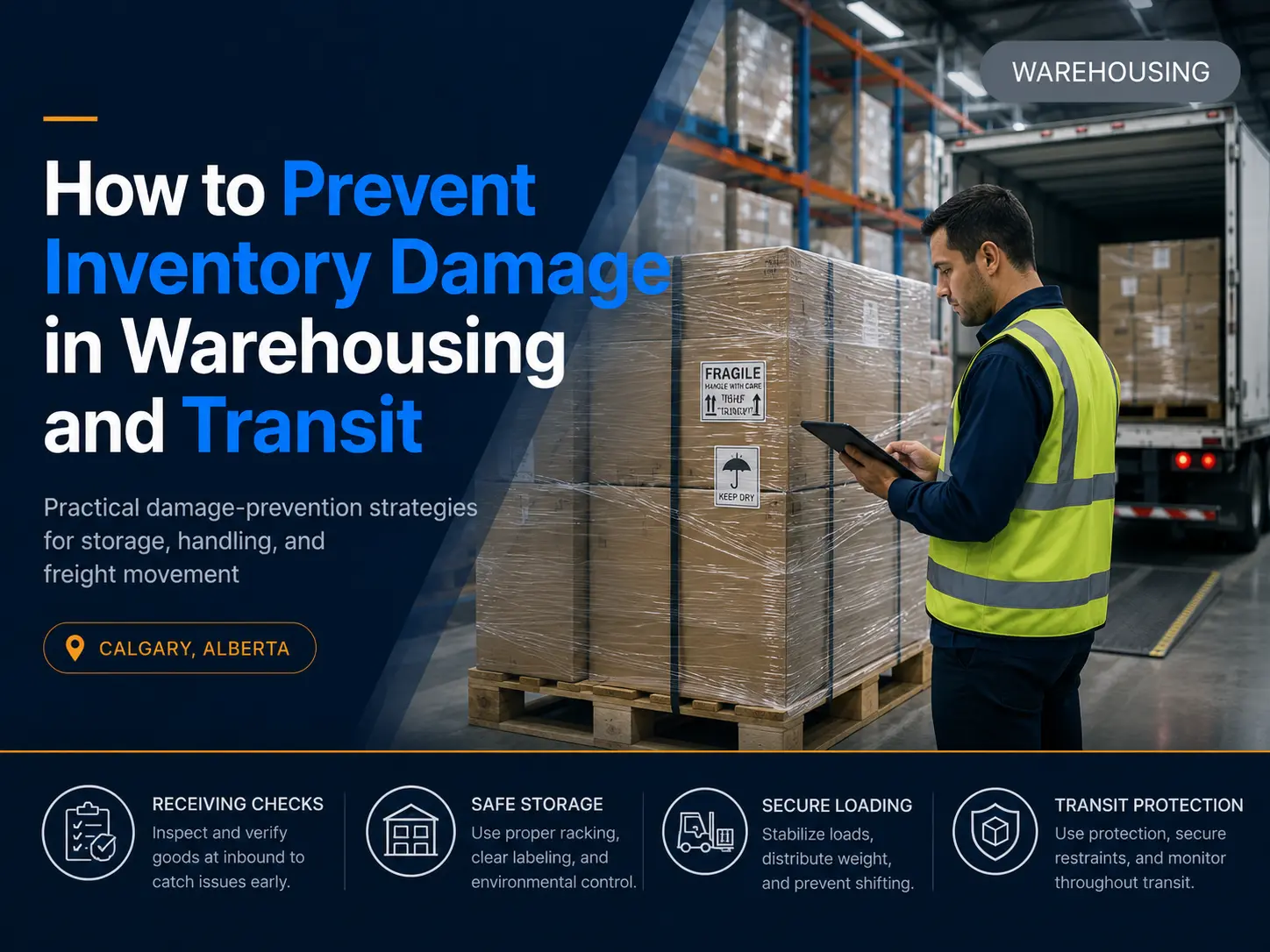
Businesses can reduce warehouse and transit damage by inspecting freight when it arrives, storing products according to their weight and handling requirements, minimizing unnecessary touches, using appropriate pallets and packaging, securing outbound loads correctly, training warehouse teams, and documenting damage risks before inventory enters the supply chain.
For businesses in Calgary and across Alberta, these controls become even more important because products may also be exposed to winter temperatures, moisture, longer highway transit, repeated loading and unloading, and significant seasonal changes in operating conditions.
At Roadway Logistics, inventory protection is approached as part of the complete warehousing and transportation process. Our warehousing services in Calgary connect receiving, organized storage, inventory handling, staging, loading, and outbound freight movement so damage prevention can be considered throughout the logistics workflow.
Where Inventory Damage Happens
Damage can occur at almost any point between a supplier and the final customer.
The important distinction is that different stages create different risks.
| Stage | Common Damage Risk | Typical Result | Main Prevention Approach |
|---|---|---|---|
| Receiving | Existing damage is missed | Damaged goods enter available inventory | Inspect and document incoming freight |
| Put-Away | Forklift or pallet contact | Dented cartons, broken packaging | Controlled handling and proper equipment |
| Storage | Poor stacking or incorrect placement | Crushing, leaning pallets, instability | Correct slotting and load limits |
| Picking | Repeated or careless handling | Drops, tears, product damage | Defined picking procedures |
| Staging | Freight sits unprotected | Impact, congestion, environmental exposure | Organized staging areas |
| Palletization | Unstable load construction | Shifting or collapsed cartons | Correct load distribution and wrapping |
| Loading | Improper trailer placement | Compression or impact damage | Load planning and securement |
| Transportation | Vibration, braking and movement | Shifted freight, broken products | Appropriate cargo securement |
| Delivery | Rough unloading | Last-stage product damage | Clear unloading procedures |
Treating all inventory damage as a “shipping problem” misses many opportunities for prevention.
A strong damage-prevention program starts before inventory is placed into storage and continues until the freight reaches its destination.
Damage Prevention Starts at Warehouse Receiving
The receiving dock is one of the most important control points in the warehouse.
If damaged freight is accepted without inspection and immediately entered into available inventory, determining when the damage occurred becomes much more difficult. Products can later be picked for customer orders, transferred between locations, or shipped to retailers before anyone identifies the problem.
A structured warehouse receiving process helps establish the condition of incoming freight before it moves deeper into the warehouse.
An effective receiving process should include several basic controls.
Inspect the Condition of Inbound Pallets
Before freight is moved into storage, warehouse personnel should look for:
- broken pallet boards
- leaning or unstable loads
- torn stretch wrap
- crushed cartons
- punctures
- moisture exposure
- loose strapping
- visible product damage
- signs that the load shifted during transportation
A damaged pallet does not automatically mean the product itself is damaged, but it should trigger closer inspection before the load enters normal storage.
Document Visible Problems
Photographs, receiving notes, quantity discrepancies, and condition records establish what the shipment looked like when it arrived.
This documentation helps distinguish damage that happened before receiving from damage that occurred later inside the warehouse.
It also gives suppliers, carriers, warehouse teams, and customers a clearer record when investigating recurring problems.
Separate Questionable Inventory
Products showing possible damage should not be mixed immediately with saleable inventory.
Separating affected goods allows them to be inspected, repacked, returned, disposed of, or otherwise processed according to the business’s requirements without accidentally reaching a customer.
Verify Quantities and Product Identification
Damage prevention is closely connected to inventory accuracy.
When products are received into the wrong location or under the wrong SKU, warehouse teams may handle inventory repeatedly while trying to correct the problem. Every additional movement creates another opportunity for damage.
A structured inventory management process can reduce unnecessary corrections later by keeping receiving, locations, SKU identification, stock visibility, and outbound movement organized.
Store Inventory According to Product Risk
Warehouse space should not be treated as interchangeable.
Different inventory requires different storage strategies based on weight, dimensions, packaging, fragility, turnover, and environmental sensitivity.
Consider Weight Before Stacking
Heavy cartons or dense products can crush lighter inventory when loads are stacked incorrectly.
Weight should be distributed consistently across the pallet, with heavier and stronger cartons generally forming the base of the load.
Uneven weight distribution can also make a pallet unstable during movement.
Respect Product and Packaging Limits
A carton may look strong enough to carry additional weight but still deform gradually during extended storage.
Long-term compression can damage:
- retail packaging
- bottles and containers
- product seals
- fragile components
- display-ready cases
Storage decisions should consider both the product and the strength of the packaging surrounding it.
Slot High-Risk Products Deliberately
Fragile, oversized, awkward, high-value, or temperature-sensitive products should be placed where warehouse teams can access them safely.
For example, forcing an unusually large item into a location designed for standard pallets may increase the risk of equipment contact or unstable storage.
The best storage location is not always the location with the most unused space.
It is the location that allows the product to be stored and retrieved safely.
Manage Environmental Exposure
Some inventory can deteriorate without being dropped or physically crushed.
Temperature fluctuations, excessive moisture, condensation, and unsuitable storage conditions may affect products such as:
- food and beverage inventory
- health and wellness products
- cosmetics and personal care goods
- sensitive packaging
- electronics
- certain industrial components
For these products, appropriate warehousing conditions are part of damage prevention.
Reduce Damage by Reducing Unnecessary Handling
Every time inventory moves, risk increases.
A pallet may be perfectly safe while stationary in a rack but exposed to impact, tipping, puncture, or shifting every time it is moved by forklift or pallet jack.
This is why efficient warehouse design contributes directly to damage prevention.
The goal should not simply be to move freight quickly.
The goal is to move it as few times as reasonably possible and with the correct equipment each time.
Improve Warehouse Slotting
High-velocity inventory should generally be positioned where it can be picked and replenished efficiently.
When frequently ordered products are stored in inconvenient locations, teams may perform more travel, more equipment movements, and more repositioning than necessary.
Better slotting can therefore improve both productivity and product protection.
Keep Warehouse Travel Paths Clear
Congested aisles increase the likelihood of:
- forklift contact
- pallet collisions
- rushed manoeuvres
- blocked sightlines
- emergency repositioning
Organized traffic flow makes warehouse operations safer for both people and products.
Use the Correct Handling Equipment
Not every load should be treated like a standard pallet.
Oversized machinery, long materials, sensitive products, furniture, fragile displays, and unusual freight may require different handling methods.
Businesses dealing with larger or irregular shipments can benefit from a logistics plan designed specifically for industrial equipment and heavy goods rather than forcing those products through a standard palletized workflow.
Avoid Excessive Rehandling
If freight is unloaded, moved to temporary storage, repositioned, transferred again, staged, and then moved once more before shipping, the number of damage opportunities quickly multiplies.
Where the shipment and delivery plan allows it, cross-docking can help reduce storage time and unnecessary handling by transferring goods more directly from inbound to outbound transportation.
Use Strong Palletization and Packaging Practices
Packaging is one of the most visible parts of inventory protection, but effective packaging is more than simply adding another layer of stretch wrap.
The entire load needs to work as a stable unit.
Start With the Pallet
A load built on a damaged pallet already has a weak foundation.
Before outbound freight is built, pallets should be checked for obvious problems such as:
- broken boards
- missing components
- protruding nails
- structural weakness
- contamination
- excessive previous damage
Build a Stable Footprint
Cartons extending significantly beyond the pallet edge are vulnerable to impact and crushing.
Where possible, the load should remain within the pallet footprint and distribute weight evenly.
Place Heavier Goods Lower
A top-heavy pallet is more likely to lean or become unstable during forklift movement and transportation.
Placing dense goods near the bottom of the load helps maintain a lower centre of gravity.
Use Appropriate Stretch Wrapping
Stretch wrap helps keep individual cartons working together as one palletized unit.
The objective is not simply to cover the load.
The wrap should stabilize the product without crushing weaker cartons or leaving the upper portion of the load loose.
Add Protection Where Required
Depending on the product, additional protection might include:
- edge protectors
- corner protection
- cushioning
- strapping
- dividers
- custom inserts
- blanket wrapping
- crates
- additional containment
The protection method should match the actual damage risk.
More packaging is not automatically better packaging.
Protect Inventory During Staging
Staging areas are sometimes overlooked because inventory may only remain there for a short period.
However, staging can be one of the busiest parts of a warehouse.
Multiple outbound loads may be assembled simultaneously while forklifts, pallet jacks, employees, carriers, and incoming freight move through nearby areas.
Poor staging creates unnecessary exposure.
A well-managed staging process should:
- keep shipments clearly separated
- maintain appropriate space between loads
- prevent pallets from blocking travel paths
- reduce last-minute rearrangement
- protect sensitive products from environmental exposure
- keep freight organized in loading sequence
When outbound loads are staged correctly, the loading process becomes faster and requires fewer emergency movements.
Prevent Damage During Trailer Loading
A perfect pallet can still arrive damaged if it is loaded poorly.
Trailer loading should account for the size, weight, shape, and stability of the freight.
Inspect the Trailer Before Loading
Before inventory enters the trailer, the loading team should check for conditions that could damage freight, such as:
- debris
- protrusions
- water
- obvious structural problems
- uneven surfaces
- contamination
For sensitive inventory, environmental conditions may also need to be considered.
Plan Weight Distribution
Heavy freight should not be positioned where it can crush lighter products or create an unstable load.
Proper distribution also contributes to safe vehicle operation.
Avoid Preventable Contact
Products should not be forced against sharp surfaces or loaded in ways that expose cartons and packaging to unnecessary pressure.
Load in the Correct Sequence
Multi-stop deliveries require additional planning.
If freight for the first stop is positioned behind several other shipments, the driver may need to move inventory repeatedly during delivery.
Correct sequencing reduces rehandling and the risk associated with it.
Prevent Freight From Shifting During Transit
Once the trailer leaves the warehouse, freight is exposed to movement that does not occur while the product is sitting in storage.
Normal transportation involves:
- acceleration
- braking
- cornering
- road vibration
- uneven pavement
- highway transitions
- changes in grade
A pallet that appears stable while stationary may behave very differently after hours on the road.
Cargo securement methods should therefore match the freight.
Depending on the shipment, protection may involve techniques such as blocking and bracing, strapping, load bars, dunnage, chocks, wedges, or other appropriate securement methods.
The objective is to prevent cargo from:
- sliding
- tipping
- rolling
- shifting sideways
- contacting other freight
- collapsing into unused trailer space
Sensitive, heavy, irregularly shaped, or high-value freight may require additional handling and securement planning beyond standard palletized transportation.
Fragile and High-Value Inventory Needs a Different Plan
Not every product has the same tolerance for vibration, impact, surface contact, temperature changes, or repeated movement.
Inventory such as electronics, medical equipment, fine furniture, precision instruments, glass products, valuable commercial goods, and sensitive machinery may require more than standard palletization.
The correct approach can include combinations of protective packaging, controlled handling, careful placement, secure transportation, and reduced handling exposure.
For these products, businesses should consider specialized handling for fragile and high-value products rather than relying on the same process used for ordinary boxed freight.
The goal is not to make every shipment more complicated.
The goal is to match the handling process to the consequence of damage.
Alberta Weather Adds Another Layer of Risk
Warehousing and transportation in Alberta introduce environmental conditions that businesses should incorporate into their damage-prevention planning.
Winter can bring freezing temperatures, snow, ice, moisture, slower highway travel, and longer exposure during loading or unloading.
Even products that do not require refrigerated or heated transportation can be affected by extreme conditions.
Freeze-Thaw Exposure
Some products, adhesives, liquids, packaging materials, and consumer goods may react poorly to repeated changes between warm warehouse environments and freezing outdoor conditions.
Moisture and Snow
Snow entering trailers, loading areas, or damaged outer packaging may lead to moisture exposure.
Wet cartons can lose structural strength and become more vulnerable to crushing during stacking or transit.
Longer Transit Periods
Weather-related delays can keep freight in transportation environments longer than originally planned.
Businesses shipping sensitive products should consider not only the normal transit time but also what happens when that transit time increases.
Icy Loading Environments
Winter conditions around docks and yards can also affect loading efficiency.
More deliberate handling and additional planning may be required when conditions make normal movements more difficult.
Damage prevention in Alberta therefore involves both warehouse controls and seasonal transportation planning. Businesses preparing for winter shipments should also review strategies to reduce freight delays during Alberta winter.
Match the Damage-Prevention Method to the Freight
Different products fail in different ways.
| Freight Type | Main Damage Risk | Typical Protection Priority |
|---|---|---|
| Standard Cartons | Crushing or punctures | Pallet quality, stacking, stretch wrap |
| Fragile Goods | Impact and vibration | Cushioning and careful handling |
| Furniture | Scratches and surface damage | Protective wrapping and controlled handling |
| Electronics | Impact, vibration, environment | Secure packaging and sensitive handling |
| Machinery | Shifting and contact | Load planning and cargo securement |
| Consumer Packaged Goods | Crushing, expiry, environmental exposure | Proper storage and inventory rotation |
| Oversized Freight | Handling impact and instability | Appropriate equipment and securement |
| High-Value Products | Damage and handling exposure | Controlled processes and documentation |
This is why businesses should be cautious about applying one standard warehouse procedure to every type of inventory.
The correct approach depends on the freight.
Inventory Damage Prevention Checklist
A practical checklist helps turn damage prevention from a general goal into a repeatable operating process.
Before Receiving
- Confirm unloading equipment is suitable for the shipment.
- Ensure receiving space is available.
- Identify products requiring special handling.
- Review any temperature or storage requirements.
During Receiving
- Inspect pallet condition.
- Inspect outer packaging.
- Look for tears, crushing, moisture, punctures, or shifting.
- Verify quantities and SKUs.
- Photograph significant visible damage.
- Record discrepancies.
- Separate damaged or questionable inventory.
During Storage
- Store inventory in suitable warehouse locations.
- Keep loads within safe stacking limits.
- Place heavy products appropriately.
- Separate fragile or sensitive goods where required.
- Maintain clear travel paths.
- Minimize unnecessary pallet movement.
- Monitor relevant environmental conditions.
During Picking and Staging
- Use appropriate handling equipment.
- Inspect packaging before shipment.
- Keep staged orders clearly separated.
- Avoid overcrowding the staging area.
- Organize freight according to loading sequence.
Before Transportation
- Inspect the trailer.
- Confirm pallet stability.
- Verify wrapping and packaging.
- Plan weight distribution.
- Use appropriate cargo securement.
- Protect sensitive freight from direct contact.
- Confirm multi-stop loading sequence.
After Delivery
- Document recurring damage patterns.
- Compare damage reports with receiving records.
- Identify whether failures occurred in packaging, handling, storage, loading, or transportation.
- Adjust the process rather than treating each damaged shipment as an isolated event.
Track Patterns Instead of Treating Every Damage Event Separately
One damaged carton may be an accident.
Twenty damaged cartons over several months are a process problem.
Businesses should look for patterns such as:
- the same SKU repeatedly arriving crushed
- damage concentrated on one side of a pallet
- recurring punctures after forklift handling
- wet cartons during particular seasons
- unstable loads from a specific supplier
- damage occurring primarily during one route or transport stage
- repeated issues during warehouse replenishment
Patterns reveal where the process needs to change.
This is where inventory records, receiving documentation, warehouse management systems, photographs, and transportation information become valuable.
The objective should be to identify the root cause, not simply dispose of the damaged product.
The Hidden Cost of Inventory Damage
The cost of damaged goods goes beyond the replacement value of the product.
A damaged shipment may also create:
- customer complaints
- returns
- reshipping costs
- labour for inspection and repacking
- inventory adjustments
- retailer disputes
- wasted packaging
- warehouse congestion
- missed delivery commitments
- emergency replacement freight
- reduced customer confidence
For growing businesses, repeated damage can also consume the time of employees who should be focused on sales, operations, and customer service.
Damage prevention is therefore not simply a warehouse quality issue.
It is a margin-protection and customer-retention strategy.
How a 3PL Can Help Reduce Inventory Damage
As businesses grow, inventory may move through more suppliers, more orders, more sales channels, and more transportation routes.
That additional complexity makes consistent handling increasingly difficult to manage through informal processes.
A professional third-party logistics operation can create repeatable procedures across:
- receiving
- inventory storage
- warehouse handling
- order picking
- staging
- packaging
- outbound loading
- transportation coordination
The advantage is not simply access to warehouse space.
It is the ability to create a controlled logistics workflow where inventory can be tracked and handled consistently from inbound receiving through outbound shipment.
For companies shipping across Calgary, Alberta, and Western Canada, combining warehousing and transportation planning can also reduce the coordination gaps that occur when several independent providers handle different stages of the same shipment.
Reduce Inventory Damage With Roadway Logistics in Calgary
Inventory should move through your supply chain without losing the quality, appearance, and value it had when it was produced.
Roadway Logistics provides warehousing, inventory handling, order fulfillment, freight handling, and transportation support for businesses moving products through Calgary, Alberta, and Western Canada.
The process can connect receiving and organized storage with picking, staging, outbound handling, cargo securement, and transportation planning.
Whether your business is dealing with recurring pallet damage, sensitive inventory, growing order volumes, seasonal transportation challenges, or freight that requires more careful handling than standard palletized goods, the first step is understanding where the damage risk exists.
From there, the warehouse and transportation workflow can be designed around the product rather than forcing every shipment through the same process.
Businesses looking for storage and distribution support can learn more about Roadway Logistics’ Calgary warehousing services or contact Roadway Logistics to discuss their inventory and freight-handling requirements.
Phone: (587) 350-7615
Email: dispatch@roadwaylogistics.ca
Calgary: 1000 55 Ave NE, Calgary, AB T2E 6Y4, Canada
Frequently Asked Questions About Preventing Inventory Damage
What Causes the Most Inventory Damage in a Warehouse?
Common causes include poor pallet condition, incorrect stacking, forklift contact, repeated handling, unsuitable storage locations, weak packaging, overcrowded staging areas, and improper loading. The exact risk depends on the type of product being stored.
How Can Warehouse Damage Be Reduced?
Start by improving receiving inspections, warehouse slotting, handling procedures, pallet quality, packaging, staging, and employee processes. Reducing unnecessary inventory movements is also important because every additional touch creates another opportunity for damage.
How Can Businesses Identify Damage When Inventory Arrives?
Inspect pallets and outer packaging before put-away. Look for crushed cartons, broken pallet boards, tears, punctures, moisture, leaning loads, loose wrapping, and other signs of shifting. Photograph and document significant issues and separate questionable goods before they enter available inventory.
How Do You Prevent Pallets From Being Damaged During Transit?
Build stable pallet loads, distribute weight correctly, use appropriate stretch wrapping or strapping, keep products within the pallet footprint where possible, inspect the trailer, and use cargo securement appropriate for the freight.
What Is Blocking and Bracing?
Blocking and bracing refers to techniques used to restrict freight movement during transportation. The objective is to prevent cargo from sliding, tipping, rolling, shifting, or contacting other freight when the vehicle accelerates, brakes, corners, or travels over uneven road surfaces.
How Should Fragile Inventory Be Stored?
Fragile products should be placed in warehouse locations where they can be accessed without unnecessary contact or repeated movement. Storage decisions should consider the product’s weight, dimensions, packaging, sensitivity, and handling requirements rather than treating all inventory the same.
Can Reducing Freight Handling Reduce Product Damage?
Yes. Every additional movement introduces another opportunity for drops, impacts, punctures, shifting, or equipment contact. Efficient receiving, storage, staging, and cross-docking processes can reduce unnecessary touches and therefore reduce handling exposure.
Does Alberta Winter Weather Increase Freight Damage Risk?
It can. Freezing temperatures, moisture, snow, longer transit times, and changing loading conditions may increase risk for certain products and packaging. Businesses shipping sensitive inventory should incorporate seasonal conditions into both their warehousing and transportation planning.
Can a 3PL Help Reduce Inventory Damage?
A 3PL can provide standardized receiving, storage, inventory management, picking, staging, and transportation processes. For businesses that have outgrown informal warehouse operations, repeatable procedures can help reduce preventable handling errors and provide better visibility into where damage occurs.
What Should I Do if Inventory Damage Keeps Happening?
Track each incident and look for patterns. Determine whether the problem originates during receiving, storage, picking, packaging, loading, transportation, or delivery. Repeated damage usually points to a process that needs to be changed rather than a series of unrelated accidents.