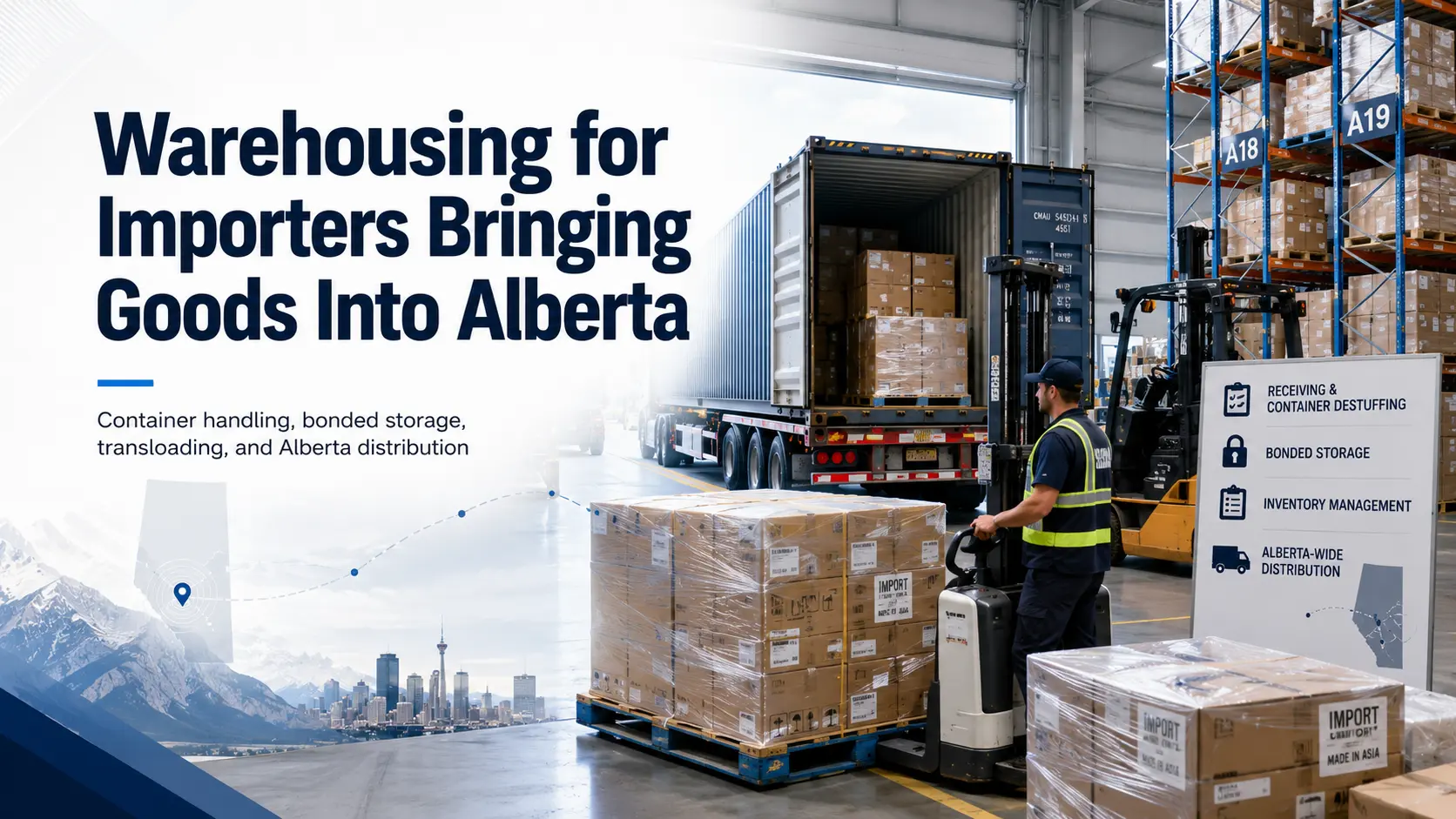
Importing goods into Alberta can create major opportunities for growing businesses, but it can also create serious logistics challenges. Once products arrive in Canada, they still need to be received, unloaded, inspected, stored, organized, labelled, palletized, tracked, and distributed to customers, retailers, job sites, or other warehouses.
That is where warehousing becomes essential.
For importers bringing goods into Alberta, warehousing is more than storage. It is the point where imported freight becomes organized inventory. A reliable warehouse helps control inbound freight, reduce delays, support customs-related processes, manage containers, prepare goods for distribution, and keep products moving across Calgary, Edmonton, Red Deer, Fort McMurray, Lethbridge, Medicine Hat, and Western Canada.
Many importers focus on ocean freight, rail freight, customs clearance, or trucking first. Those steps matter, but the warehouse is where the real supply chain control begins. Without the right warehousing partner, goods can sit in containers too long, inventory can become difficult to track, and customers may wait longer than expected.
Roadway Logistics supports importers with warehousing, transloading, container handling, bonded warehouse support, cross docking, drayage, LTL transportation, FTL transportation, local cartage, pick and pack, and regional distribution in Calgary and across Alberta.
This guide explains why warehousing matters for importers bringing goods into Alberta, what services importers should look for, and how a Calgary warehouse can help create a smoother import supply chain.
What Is Import Warehousing?
Import warehousing is the process of receiving, storing, managing, and distributing goods after they arrive from outside Canada or from another province. These goods may arrive by ocean container, rail, truck, trailer, or intermodal shipment.
For importers, warehousing may include:
| Import Warehousing Service | What It Means |
| Warehouse receiving | Goods are received, checked, and entered into inventory |
| Container destuffing | Products are unloaded from an import container |
| Transloading | Freight is transferred from one mode or equipment type to another |
| Short-term storage | Goods are stored temporarily before final delivery |
| Long-term storage | Inventory is held until needed for sale or distribution |
| Palletizing | Loose cargo is organized onto pallets |
| Re-palletizing | Damaged or unstable pallets are rebuilt |
| Inventory management | Stock is counted, tracked, and organized |
| Pick and pack | Products are selected, packed, and prepared for shipment |
| Cross docking | Freight moves quickly from inbound to outbound transport |
| Regional distribution | Goods are shipped across Calgary, Alberta, or Western Canada |
A good import warehouse helps turn inbound freight into usable, trackable, and deliverable inventory.
Why Importers Need Warehousing in Alberta
Alberta importers often serve customers across large geographic areas. A shipment may arrive in Calgary but need to move to Edmonton, Red Deer, Lethbridge, Fort McMurray, Grande Prairie, or another Western Canada destination. Without proper warehousing, this movement can become expensive and disorganized.
Warehousing helps importers solve common problems such as:
| Importer Challenge | How Warehousing Helps |
| Containers need to be unloaded quickly | Container destuffing and warehouse receiving keep freight moving |
| Goods are not ready for final delivery | Short-term staging provides time to sort and prepare inventory |
| Inventory arrives in bulk | Warehousing allows goods to be stored and released as needed |
| Shipments need to go to multiple customers | Freight can be sorted, picked, packed, and distributed |
| Imported goods need duty/tax control | Bonded warehouse support may help defer duties and taxes |
| Pallets are damaged or unstable | Re-palletizing and pallet rework improve safety |
| Product labels or packaging need updates | Value-added warehousing can support labelling and packaging |
| Freight needs to move across Alberta | LTL, FTL, and regional distribution support final delivery |
For importers, the warehouse is not just a place to put products. It is a control point for cost, timing, inventory accuracy, and customer service.
Why Calgary Is a Strong Warehousing Location for Importers
Calgary is one of the most important logistics locations in Alberta. It connects businesses to major highways, rail networks, airport-area freight, industrial parks, and regional distribution routes. For importers bringing goods into Alberta, Calgary warehousing can support both local delivery and wider Western Canada distribution.
A Calgary warehouse can help importers serve:
- Calgary and surrounding business areas
- Airdrie, Balzac, Chestermere, Okotoks, and Cochrane
- Red Deer and Central Alberta
- Edmonton, Nisku, Leduc, and Sherwood Park
- Lethbridge, Medicine Hat, Brooks, and Southern Alberta
- Fort McMurray and Northern Alberta
- British Columbia, Saskatchewan, and Manitoba shipping lanes
Many importers use Calgary as a staging point because goods can be received, stored, sorted, and distributed from one central Alberta location. This can reduce unnecessary freight movement and improve response times for customers across the province.
How Imported Goods Move Through a Warehouse
A strong import warehousing process should be organized from the moment freight arrives. Imported goods often come with tight delivery schedules, container deadlines, product handling requirements, and customer commitments.
Here is a simple overview of how imported goods usually move through a warehouse.
| Step | What Happens | Why It Matters |
| 1. Arrival coordination | The inbound container, trailer, or truck is scheduled | Prevents dock congestion and delays |
| 2. Receiving | Goods are unloaded and checked against paperwork | Confirms what arrived |
| 3. Inspection | Products, packaging, pallets, and quantities are reviewed | Identifies damage or shortages |
| 4. Palletizing or rework | Loose or unstable freight is organized | Improves handling and storage safety |
| 5. Inventory entry | Goods are added to the inventory system | Supports stock visibility |
| 6. Storage | Products are placed in racks, bulk space, or staging zones | Keeps inventory organized |
| 7. Value-added work | Labelling, packaging, kitting, or assembly may be completed | Prepares goods for sale or delivery |
| 8. Order preparation | Goods are picked, packed, or staged | Supports fulfillment and outbound shipping |
| 9. Distribution | Freight moves by LTL, FTL, cartage, or courier | Gets products to customers or stores |
This process helps importers avoid confusion after goods arrive. It also gives the business more control over inventory, delivery timing, and customer expectations.
Bonded Warehouse Support for Importers
Some importers may benefit from bonded warehouse support. A bonded warehouse is a secure warehouse environment where imported goods may be stored under customs control before duties and taxes are paid. This can help importers manage cash flow and control when goods are released into the Canadian market.
Bonded warehouse support can be useful when:
- Goods are imported in bulk
- Inventory will be sold gradually
- Products may be re-exported
- Importers want to defer duty and tax payments
- Goods need storage before final release
- Products need labelling, packaging, or preparation
- Importers need more flexibility in the supply chain
Bonded warehousing is especially helpful for businesses that import large volumes or manage international distribution. Instead of paying duties and taxes on all imported goods immediately, the importer may be able to pay when goods are released for domestic sale.
Bonded Warehouse vs Standard Warehouse vs Cross Dock
Importers often need to understand the difference between bonded warehousing, standard warehousing, and cross docking.
| Option | Best For | Main Benefit |
| Bonded Warehouse | Imported goods under customs control | Helps defer duties and taxes until release |
| Standard Warehouse | Goods ready for storage, sale, or distribution | Supports inventory management and order fulfillment |
| Cross Dock | Freight that needs quick transfer | Reduces storage time and speeds up distribution |
| Transloading Facility | Freight moving between containers, rail, trucks, or trailers | Helps transfer and prepare goods for final delivery |
| Short-Term Staging | Goods waiting for pickup, sorting, or delivery | Provides flexibility without long-term storage |
The best option depends on the shipment type, customs status, delivery timeline, storage needs, and final destination.
Container Destuffing for Importers
Many importers bring goods into Alberta through ocean containers that move inland by rail or truck. Once the container arrives, the goods must be unloaded. This process is called container destuffing.
Container destuffing may include:
- Opening the container
- Unloading floor-loaded cargo
- Removing palletized freight
- Checking product counts
- Inspecting visible damage
- Sorting goods by SKU or destination
- Palletizing loose cargo
- Re-palletizing unstable freight
- Wrapping pallets
- Labelling freight
- Moving goods into storage or outbound staging
Fast and organized container destuffing can help reduce delays. It also helps importers avoid warehouse confusion by creating a clear record of what was received.
Transloading and Import Warehousing
Transloading is closely connected to import warehousing. It means moving freight from one transportation mode or equipment type to another. For example, goods may move from an ocean container into a warehouse, then onto pallets, trailers, LTL shipments, or regional delivery trucks.
Importers use transloading when:
- Goods arrive in containers but need truck delivery
- Freight must be separated by customer or destination
- Products need storage before final delivery
- Loose cargo needs palletizing
- Shipments must be consolidated or deconsolidated
- Inventory must move across Alberta or Western Canada
- A container needs to be unloaded quickly
When transloading and warehousing work together, importers get more flexibility. Products can be received, sorted, stored, repacked, and shipped based on actual business needs instead of being forced into one delivery schedule.
Inventory Management for Imported Goods
Inventory management is one of the most important parts of import warehousing. Once goods arrive, importers need to know what is in stock, where it is stored, how much is available, and when it can ship.
Poor inventory control can lead to:
- Overselling products
- Delayed orders
- Missing stock
- Incorrect shipments
- Higher labour costs
- Customer complaints
- Extra storage fees
- Confusion between available, damaged, and pending inventory
A professional warehouse helps manage imported inventory through organized receiving, SKU tracking, pallet locations, cycle counts, order picking, and inventory reporting.
Important inventory services include:
| Inventory Service | Why It Matters |
| SKU management | Helps track different product types |
| Lot tracking | Useful for batch-based goods |
| Pallet location control | Makes stock easier to find |
| Cycle counts | Helps maintain inventory accuracy |
| Damage reporting | Separates damaged goods from sellable stock |
| Order picking | Supports customer fulfillment |
| Inventory visibility | Helps importers plan sales and distribution |
For importers, inventory accuracy protects revenue. Goods that cannot be located or counted correctly cannot be sold efficiently.
Value-Added Warehousing for Importers
Imported goods often need more than storage. Many products require preparation before they are ready for customers, retail shelves, job sites, or distribution centres.
Value-added warehousing may include:
- Labelling
- Re-labelling
- Packaging
- Repackaging
- Kitting
- Light assembly
- Palletizing
- Re-palletizing
- Shrink wrapping
- Sorting
- Quality checks
- Order preparation
- Pick and pack
- Return handling
These services help importers avoid sending products to multiple vendors. Instead of using one company for storage, another for labelling, and another for distribution, importers can manage more steps through one warehouse partner.
This can reduce handling, improve timing, and make the supply chain easier to manage.
Short-Term Storage vs Long-Term Storage
Importers may need different storage options depending on product demand and shipment timing.
| Storage Type | Best For | Example |
| Short-Term Storage | Goods waiting for delivery, sorting, or release | Container arrives before customer pickup is ready |
| Long-Term Storage | Inventory held until sold or needed | Imported retail products stored for seasonal demand |
| Overflow Storage | Extra stock during busy periods | A business receives more inventory than its own facility can hold |
| Bonded Storage | Imported goods under customs control | Goods are stored before domestic release or re-export |
| Staging | Goods prepared for outbound delivery | Pallets are sorted by route or customer |
Importers often use a mix of storage types. For example, a container may be destuffed, some goods may move directly through cross docking, some may go into short-term staging, and the remaining inventory may go into long-term warehouse storage.
Cross Docking for Imported Goods
Cross docking is useful when imported goods do not need long-term storage. Instead, freight moves quickly from inbound receiving to outbound delivery.
For importers, cross docking can help when:
- Goods are already sold before arrival
- Products need quick delivery to customers
- Freight is moving to multiple Alberta cities
- Inventory should not sit in storage
- Retail distribution needs fast replenishment
- Job-site deliveries are time-sensitive
- Imported goods need sorting by route
Cross docking can reduce storage costs and shorten delivery timelines. It is especially helpful for high-demand products, seasonal goods, retail replenishment, and fast-moving inventory.
Distribution Across Alberta and Western Canada
Warehousing for importers should connect directly to transportation. Storage is only useful if goods can move out efficiently when needed.
Roadway Logistics supports importers with transportation services that may include:
- LTL shipping Calgary
- FTL transportation Calgary
- Local cartage
- Regional Alberta distribution
- Calgary to Edmonton freight
- Calgary to Red Deer freight
- Calgary to Fort McMurray freight
- Calgary to Lethbridge freight
- Calgary to Medicine Hat freight
- Western Canada freight movement
- Cross docking and delivery coordination
- Container handling and drayage
- Flat deck and specialized freight support
For importers, this means goods can be received into a Calgary warehouse and then distributed based on customer demand. Instead of sending every shipment separately from the port or supplier, inventory can be staged locally and released in a planned way.
Industries That Use Import Warehousing in Alberta
Many industries rely on import warehousing in Calgary and Alberta.
| Industry | Common Imported Goods | Warehousing Needs |
| Retail | Consumer goods, packaged products, store inventory | Storage, pick and pack, labelling, distribution |
| E-commerce | Online products, small parcel goods, seasonal stock | Fulfillment, inventory tracking, returns |
| Construction | Fixtures, materials, equipment, tools | Bulk storage, staging, job-site delivery |
| Manufacturing | Components, parts, raw materials | Inventory control, inbound logistics |
| Oil and gas | Industrial parts, equipment, supplies | Secure storage, specialized handling |
| Automotive | Parts, accessories, components | SKU tracking, pallet storage, distribution |
| Furniture | Imported furniture, home goods, fixtures | Container destuffing, storage, delivery coordination |
| Agriculture | Equipment, supplies, packaged products | Bulk storage and regional freight |
| Wholesale distribution | Mixed inventory and palletized goods | Storage, picking, cross docking, freight consolidation |
Each industry has different requirements, but the core need is the same: imported goods must be handled safely, tracked accurately, and distributed efficiently.
Common Import Warehousing Problems
Importers often run into problems when warehouse planning is done too late. Waiting until the container is already arriving can create pressure and extra costs.
Common problems include:
| Problem | Business Impact |
| No warehouse space booked | Containers may sit longer than expected |
| Poor receiving process | Inventory records become inaccurate |
| No container destuffing plan | Unloading takes longer and creates delays |
| No palletizing support | Loose cargo becomes harder to store and ship |
| Weak inventory tracking | Products are difficult to locate |
| No distribution plan | Goods sit in storage without a clear next step |
| Damaged goods not separated | Unsellable stock may mix with good inventory |
| Lack of communication | Importers do not know shipment status |
| Wrong warehouse location | Final delivery becomes more expensive |
A good import warehousing plan should be created before goods arrive. This gives the importer, warehouse, carrier, and customer a clear process.
How Warehousing Helps Reduce Import Costs
Warehousing has a cost, but poor warehousing usually costs more. Importers can reduce total supply chain costs when warehousing is planned properly.
Warehousing can help reduce costs by:
- Preventing rushed freight decisions
- Reducing container delays
- Supporting efficient unloading
- Improving inventory accuracy
- Reducing repeated handling
- Consolidating shipments
- Supporting LTL and FTL planning
- Reducing missed deliveries
- Improving customer fulfillment
- Preventing unnecessary storage overflow
- Supporting duty and tax deferral through bonded warehouse options
- Helping damaged goods get separated quickly
Cost control depends on visibility. When importers know what arrived, where it is stored, and when it needs to move, they can make better shipping and sales decisions.
What to Look for in a Calgary Warehouse Partner
Choosing the right warehouse partner is important. Importers should look for more than empty space. The right partner should understand freight movement, customs-related timing, container handling, inventory control, and regional distribution.
A strong warehouse partner should offer:
| What to Look For | Why It Matters |
| Calgary location | Supports Alberta and Western Canada distribution |
| Container destuffing | Helps unload import containers efficiently |
| Transloading | Supports container, rail, truck, and trailer transfers |
| Bonded warehouse support | May help with duty and tax deferral |
| Inventory management | Keeps stock accurate and visible |
| Cross docking | Supports fast movement without long storage |
| LTL and FTL trucking | Moves goods to customers and stores |
| Local cartage | Supports Calgary-area delivery |
| Palletizing and rework | Makes freight safer and easier to handle |
| Flexible storage | Helps with seasonal demand and changing volumes |
| Communication | Keeps importers updated on freight status |
Importers should also ask about dock scheduling, warehouse security, product handling, storage options, turnaround time, inventory reporting, and outbound transportation.
Why Work With Roadway Logistics?
Roadway Logistics helps importers bringing goods into Alberta with practical warehousing and freight support in Calgary and across Western Canada. Our services are designed to help businesses receive, organize, store, and move imported goods with less confusion.
We can support importers with:
- Warehousing in Calgary
- Import warehousing in Alberta
- 3PL warehousing support
- Bonded warehouse support
- Container destuffing
- Container stuffing
- Transloading
- Drayage
- Container handling
- Cross docking
- Short-term staging
- Long-term storage
- Palletizing
- Re-palletizing
- Pick and pack
- Inventory management
- Local cartage
- LTL shipping
- FTL transportation
- Regional distribution
- Western Canada freight movement
Whether your goods arrive by container, rail, truck, or trailer, Roadway Logistics can help receive and prepare your freight for the next step.
Import Warehousing Checklist
Before your next shipment arrives, use this checklist to plan your warehouse needs.
| Question | Why It Matters |
| When will the goods arrive? | Helps schedule receiving and unloading |
| Are goods floor-loaded or palletized? | Determines labour and equipment needs |
| Do you need container destuffing? | Helps plan unloading time |
| Do goods need bonded storage? | Supports duty and tax planning |
| How many SKUs are arriving? | Helps prepare inventory tracking |
| Are products going to multiple customers? | Helps plan sorting and distribution |
| Do goods need labelling or packaging? | Supports value-added warehousing |
| Do you need short-term or long-term storage? | Helps choose the right storage setup |
| Will goods ship by LTL or FTL? | Helps plan outbound freight |
| Are any products fragile, high-value, or oversized? | Helps plan specialized handling |
| Do you need delivery across Alberta? | Helps coordinate regional distribution |
A clear plan helps prevent delays and keeps imported goods moving smoothly.
A Word From Roadway Logistics
Warehousing is one of the most important parts of the import process. Once goods arrive in Alberta, they need to be handled properly, stored safely, tracked accurately, and moved efficiently. Without the right warehouse plan, importers may face delays, inventory errors, extra costs, and customer service problems.
For importers bringing goods into Alberta, a Calgary warehouse can provide the control needed to manage imported inventory and distribute products across the province. Whether you need bonded warehouse support, container destuffing, transloading, short-term storage, pick and pack, cross docking, LTL shipping, FTL transportation, or regional distribution, the right logistics partner can make the process easier.
Roadway Logistics helps importers move freight through Calgary and across Alberta with practical warehousing and transportation solutions. If your business is importing goods and needs reliable warehouse support, Roadway Logistics is ready to help.
Get Warehousing Support for Imported Goods in Alberta
Need warehousing for imported goods in Calgary or across Alberta?
Contact Roadway Logistics today for import warehousing, bonded warehouse support, container destuffing, transloading, drayage, cross docking, LTL shipping, FTL transportation, pick and pack, and regional distribution support.
Let Roadway Logistics help your imported goods move from arrival to storage to delivery with confidence.
FAQs About Warehousing for Importers in Alberta
What is import warehousing?
Import warehousing is the process of receiving, storing, managing, and distributing goods after they arrive from outside Canada or another region. It may include container destuffing, inventory management, bonded storage, pick and pack, cross docking, and regional distribution.
Why do importers need warehousing in Calgary?
Calgary is a strong logistics location for Alberta and Western Canada. A Calgary warehouse helps importers receive goods, store inventory, manage distribution, and serve customers across Calgary, Edmonton, Red Deer, Fort McMurray, Lethbridge, Medicine Hat, and surrounding areas.
What is a bonded warehouse?
A bonded warehouse is a secure warehouse where imported goods may be stored under customs control before duties and taxes are paid. This can help importers manage cash flow and release goods as needed.
What is container destuffing?
Container destuffing is the process of unloading goods from an import container. It may include inspection, sorting, palletizing, labelling, and moving goods into storage or outbound staging.
What is the difference between warehousing and cross docking?
Warehousing is used when goods need storage and inventory control. Cross docking is used when goods move quickly from inbound freight to outbound delivery with little or no storage time.
Can imported goods be stored short-term?
Yes. Importers often use short-term storage when goods arrive before customer delivery, customs release, packaging work, or final distribution is ready.
Can Roadway Logistics help with warehousing for importers?
Yes. Roadway Logistics supports importers with warehousing, bonded warehouse support, transloading, container destuffing, drayage, cross docking, LTL, FTL, local cartage, pick and pack, and regional distribution in Calgary and across Alberta.